
During the Great Depression of the 1930s, economic collapse pushed hundreds of thousands of American men onto the roads and railways, forming a drifting underclass with its own rules, culture, and language.
Hobos were itinerant workers, travelling voluntarily — often riding the rails (jumping in railway carts)— in search of seasonal or odd jobs. Tramps travelled but avoided work when possible. Bums neither travelled nor worked and bludged off others.
The Coen Brothers movie, O Brother, Where Art Thou?, starring George Clooney, is a good snapshot of the era as it follows the epic journey of three escaped convicts drifting through Depression-era Mississippi.
To survive, hobos developed a system of symbols quietly scratched onto fences, posts, and buildings. These markings conveyed secret information: “food available for work”, “kind woman lives here”, or the darker warning, “a dishonest man lives here.” It was an underground language built on trust and shared hardship.
That hidden world is memorably brought to life in an early episode of the AMC series Mad Men. A young Don Draper watches a hobo carve a strange symbol into the fence outside his family’s home. Later, he learns its meaning: the man had worked for Don’s father, wasn’t paid, and left a warning for those who might follow—a few simple lines etched into timber carried real consequence.
History and Hollywood have a way of priming our imaginations — especially during times of economic downturn. Living costs are skyrocketing, and faith in government is at all time lows.
Have we entered a New Depression?
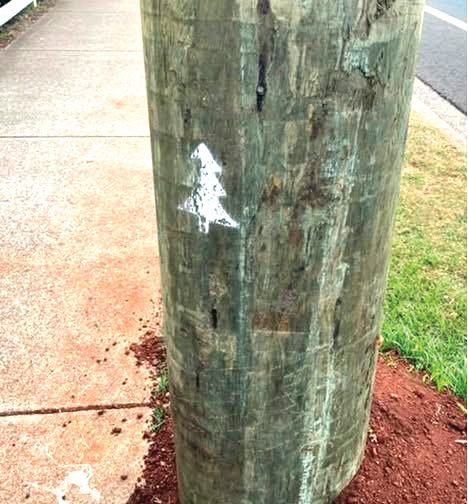
That’s where these strange white Christmas tree symbols enter the scene. Childers and Bundaberg locals have been spotting these symbols popping up everywhere on power poles throughout the region.
Surely, it’s too far of a stretch to believe that Childers and Bundaberg residents suddenly have hobos roaming the streets, quietly etching warnings onto telegraph poles.
This isn’t Depression-era America — even though the Treasury and the RBA are doing their best to put us there.
Ok. You can all relax.
We got the lowdown on the meaning behind these strange symbols. It’s less exciting than we imagined.
The white “pine tree” symbol simply identifies a plantation softwood power pole installed by Ergon Energy.
As slow-growing hardwoods become harder to source, treated softwood poles —resistant to termites and rot — are becoming more common across Queensland.
Some trial poles installed in the 1970s are still standing today.
No hobos.
No warnings.
No secret messages — just power poles doing their job, even if they gave us a moment to wonder.
Chitchat Newspaper. March 2026.