
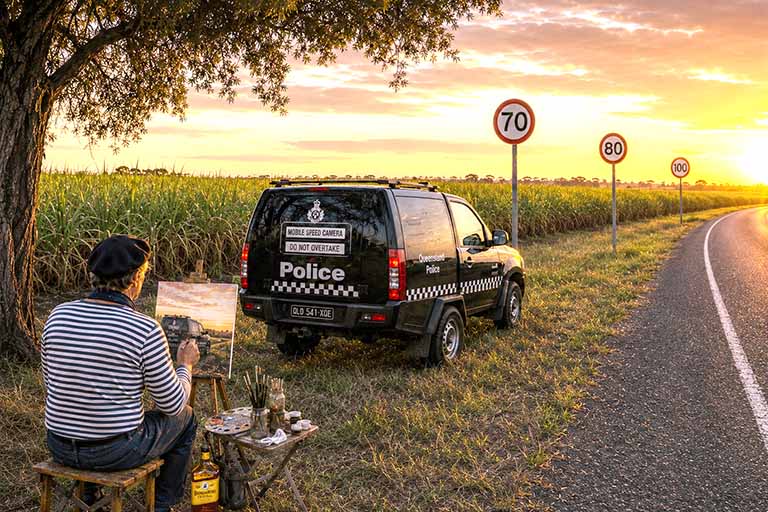
Bundaberg Speed Camera Artwork
A curious new “community art movement” has reportedly appeared around the Bundaberg Region. The community art crusade operates under the official-sounding title: “Curb-Side Observations Project” — or COP for short.
The concept is simple. Local artists quietly set up near mobile speed camera vehicles and produce sketches, paintings, and watercolours of what organisers call “21st-century roadside surveillance art.”
Supporters insist the project is deeply cultural. Critics insist it is deeply suspicious.
According to advocates, the artworks explore themes of “stationary enforcement of motion,” “public observation,” and “the relationship between authority and landscape.” Strangely, however, benefactors and collectors seem overwhelmingly interested in paintings featuring the rear of the speed camera vehicle — particularly the camera itself.
Artists claim they are operating entirely lawfully from public areas and are merely “capturing the civic spirit of the modern Queensland surveillance state.” Some have reportedly described the speed camera car as “a still-life with fines.”
Concerns have now emerged that the presence of easels, folding chairs, and highly talented artistic expression near enforcement vehicles may unintentionally influence driver behaviour.
Some motorists allegedly slow down upon noticing artists intensely painting the back of a suspiciously parked hatchback.
Importantly, no evidence has been produced showing the artwork interferes with the camera’s field of view, and no laws currently prohibit Australians from painting mobile speed cameras.
At this stage, the project remains an unresolved question for the community:
Is COP a meaningful form of public art?
A conceptual protest of speed cameras in disguise?
Or maybe the Curb-Side Observations Project is the first time a landscape painting has threatened Queensland revenue projections?
Editorial Note
The publication emphasises that this proposal is currently unverified as a commercial venture and is being presented strictly for community discussion. The central question remains open: Is this a legitimate form of participatory public art — or an example of artistic practice going too far?
Chitchat Newspaper. June 2026