
Different Possibilities in Property and Retirement
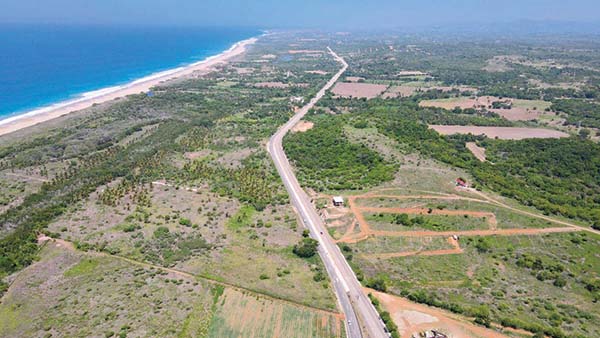
A recent visit to Mexico’s Pacific coast provided an opportunity to compare Australia’s Wide Bay and Southern Great Barrier Reef region with coastal Mexico—not only in lifestyle and property prices, but in the structure of property ownership itself.
Property as a universal concept: land, buildings, ownership, and investment. But on closer inspection, you realise that “ownership” varies significantly from country to country. Nowhere is that contrast clearer than between Australia and Mexico.
Australia’s property system sits on a highly structured registration framework, built on British Common Law. Today, it is anchored to a state-guaranteed register known as the Torrens Title System. If your name is on the title, you are, in almost all cases, the legal owner.
On the other side of the Pacific, the legal landscape is shaped by a tradition of codified civil law dating back to Roman times. Civil law is more whimsical and not shaped by case law over time. Ownership is often supported through notarised instruments such as the Escritura Pública, alongside a public registry. The result is structured and formal, but less predictable.
The Oaxacan Coast
Puerto Escondido, or Hidden Port in English, is a town shaped by the ocean in the most literal sense. Surf breaks like the famous Mexican Pipeline draw international attention. Smaller beaches such as Playa Carrizalillo sit tucked into the headlands, offering calmer water, beautiful scenery, and a slower pace of life. The food is amazing, and the community is welcoming.
Further along the coast, Santa María Huatulco presents a more planned environment—resort bays, an international airport, and seasonal connectivity into North America, including routes to cities like Vancouver.
The climate is very favourable. Warm year-round, with rainfall arriving in predictable afternoon bursts around 4 pm like clockwork during the wet season, before clearing again.
The Market Shift
Over recent years, coastal Oaxaca has attracted increasing attention from US and Canadian property buyers. Prices exploded during COVID. There is a clear split in how locals view this shift. Some see opportunity, others see pressure on housing, rents, and long-term access to coastal areas.
In popular suburbs, local landowners have sold off parcels at heavily inflated prices. They walk away happy, ride off into the sunset in a new Hilux, and have a wad of disposable pesos. Some relocate inland or further down the coast to quieter areas, others reinvest, and some shift into entirely different forms of work.
There’s a more complicated reaction among those who don’t own land. For some, rising prices and rents have pushed housing further out of reach, and there’s a sense of being colonised by Gringos who move in and reshape their way of life.
How Foreign Ownership Works
Unlike Australia, where property ownership is fairly straightforward, foreign ownership in coastal Mexico operates through a maze of legal mechanisms.
Gringos (foreigners) can’t own property along the border or coastal regions of Mexico. But that’s where all the most popular properties are. The government doesn’t want them to own the land, but they do like those investment dollars.
Whatever should they do?
They invented the Fideicomiso – and just like that, you can side-step the constitution.
The fideicomiso is a bank trust that allows foreign buyers to hold property rights in constitutionally restricted coastal zones. It is allowed because the trust is Mexican and it owns the asset.
In simplified form:
A Mexican bank holds legal title to the property. The foreign buyer is named as beneficiary. The beneficiary retains rights to use, lease, sell, and pass the property on. It functions as a legal bridge between domestic ownership rules and foreign investment.
Company structures are also used in some cases, though they introduce additional compliance and administrative complexity.
Have fun corralling an accountant to file regular tax updates on your behalf and visiting the Notaria to make even the slightest change to a document.
Where Risk and Certainty Diverge
Property in the region tends to fall into three broad categories of legal standing—each with a different level of certainty and reliance on underlying documentation.
At the most secure end is escritura pública, where ownership is formally notarised and recorded in the public registry. This is the closest equivalent to fully registered title in Mexico and is generally the most bankable and widely recognised form of ownership.
Below that sits ejido land, governed under Mexico’s communal land framework. While some ejido land can be converted into private ownership under specific legal processes, the pathway is far from simple.
This type of land purchase is where foreigners can get themselves into trouble. We met a man who flies back and forth from Chicago to attend the Communal Land Court. His title is being disputed, and it is costing a fortune in fees and wasted time.
Further down the scale are possession-based arrangements, sometimes documented through an acta de posesión, where occupation and local recognition form part of the claim. These can function in practice, but legal certainty depends heavily on individual circumstances and the strength of supporting documentation. You want to trust the person you’re buying from.
What the Market Looks Like in Practice
Price variation across the region reflects this legal layering as much as location.
At the lower end, possession-based land near the Puerto Escondido region can range approximately between 400,000 to 550,000 Mexican pesos (Roughly $36,000 to $50,000 AUD). These parcels are typically located in developing fringe areas—flat land, partial infrastructure, and early-stage expansion zones.
At the other end of the spectrum, fully titled homes with escritura pública begin from around $50,000 AUD equivalent in lower-cost areas and extend significantly higher depending on proximity to the coast and build quality.
One mid range example near Puerto Escondido is listed at approximately 5.3 million Mexican pesos (Roughly $480,000 AUD). The property includes multiple living spaces, a pool, guest accommodation, and a layout designed for both full-time living and short-term rental use.
Higher-end properties push well into the multimillion-dollar ballpark, and there is certainly no shortage of such houses.
The Listings on the Ground
Early-stage land near expanding corridors is often marketed around future infrastructure—roads, airports, and projected growth zones. They usually come in the form of an acta de posesión.
Residential developments between coastal towns tend to sell a vision of planned communities, ocean proximity, and long-term design concepts, often ahead of full service completion. They also usually come in the form of an acta de posesión.
Established homes in built-up centres are more conventional: they usually hold escritura pública title, completed construction, connected services, and are already functioning as rentals or primary residences.
Closing Observation
The visit to Puerto Escondido highlighted how differently the same asset class—land and housing—can behave depending on the underlying legal and institutional structure.
Within a single coastal region, property can range from sub-$50,000 AUD parcels through to multi-million-dollar established homes
Cheap Safe Ocean View Land
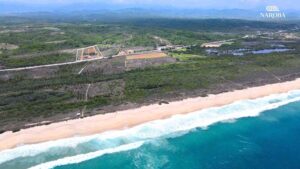
Located just 35 minutes from Puerto Escondido, NAROBA Residencial offers residential lots with ocean views, public deeds, and easy access to the beaches of Mazunte, Zipolite, and Huatulco.
Lot sizes range from 200 m² to 498 m², with water and electricity services already available and a gated entrance planned soon.
Designed as a peaceful, nature-focused community, the development combines affordability, legal security, and long-term investment potential.
Price: 400,000 MXN (approximately 32,000 AUD, depending on exchange rates).
Compared to coastal land in Australia, where ocean-view blocks can easily exceed 1 million AUD, this represents a significantly lower entry cost with strong upside potential in a growing tourism region.
The key advantage is public deeds, offering more secure ownership compared to many informal land developments in emerging markets.
Mid Range Traditional House

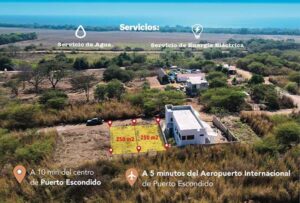
Located in Granjas del Pescador, Puerto Escondido, just 5 minutes from the airport, this tropical property offers a peaceful lifestyle with strong rental potential.
Built 3.5 years ago on a 460 m² lot with 140 m² of construction, the property includes a main house and separate guest house, each with 1 bedroom and 1 bathroom.
Features include traditional palapa roofs, a superadobe swimming pool, tropical gardens, and full water and electricity services.
Price: 5,300,000 MXN (approximately 425,000 AUD).
Compared to a similarly priced property in regional Australia, this offers significantly lower entry cost, dual-living flexibility, and strong vacation rental appeal.
Unlike many coastal Mexican properties, this one also comes with public deeds, reducing legal risk and making ownership more secure for buyers.
Luxury Beach House

Located in the heart of La Punta, Puerto Escondido, this modern 4-bedroom, 4.5-bathroom property is just a short walk to the beach, restaurants, cafés, and bars.
Built in 2023 on a 300 m² lot, it operates successfully as an Airbnb with an estimated 15–20% ROI. Features include a pool, solar panels with batteries, private terraces, storage, and parking. Sold fully furnished and move-in ready.
Price: 16,000,000 MXN (approximately 1.28 million AUD).
Compared to a 1.3 million AUD home in Bargara, this property offers stronger vacation rental potential, year-round tourism demand, and lower operating costs.
The main risk is that the property is held under an “Acta de Posesión” rather than full title deeds, which can create legal uncertainty, financing limitations, and additional due diligence requirements for foreign buyers.
Chitchat Newspaper. June 2026.