
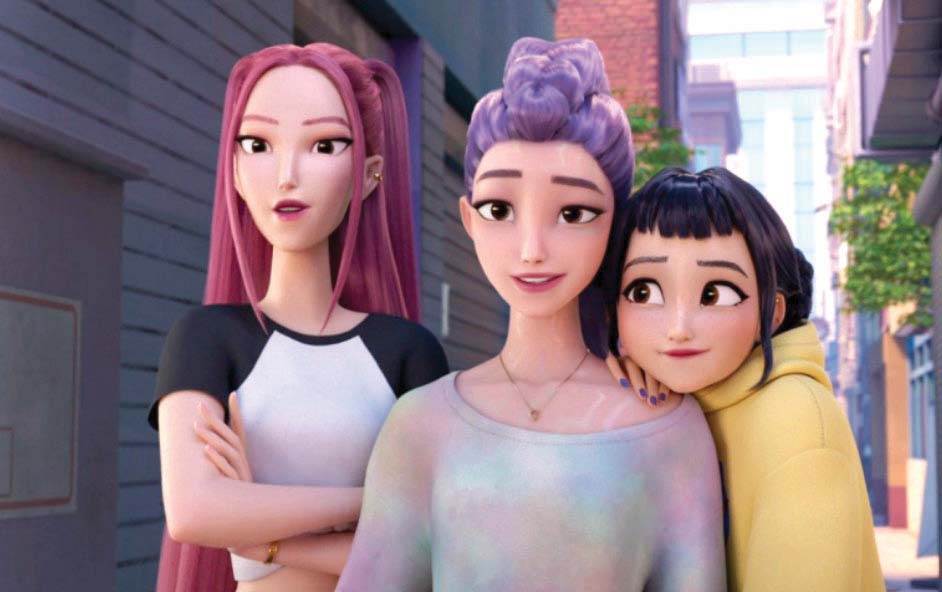
As a family, we always try to carefully vet movies before watching them with the kids. So when we first heard about KPop Demon Hunters, a children’s movie with the word “demon” in the title immediately raised concerns for us. We held off letting the kids watch it for as long as we could because we wanted to make sure it was something worth introducing to our kids.
Then one day our daughter came home happily singing “Gunna be, gunna be golden…” Curiosity won. So we sat down together, cautiously pressed play and before long our shoulders were bopping along to “My little soda pop…”
What surprised us was a story with far more emotional depth than we expected.
Movie Summary
The movie follows the globally famous K-pop singing group Huntr/x — Rumi, Mira, and Zoey — who secretly protect the world from demons. Their music strengthens the Honmoon, a magical barrier that separates the human world from the demon world.
The demon king Gwi-Ma wants to break the Honmoon so demons can consume human souls. He creates a rival idol boy band called Saja Boys, led by Jinu, to weaken the girls and damage the Honmoon.
While the movie is filled with action, music and comedy, there are deeper themes in play.
Light and Dark
The movie introduces the idea of light and dark, good and bad, and the struggle between hope and shame. Suggesting that shame grows stronger when hidden, but weaker when brought honestly into the light.
Purpose
Rumi, Mira, and Zoey are famous performers, but secretly they are demon hunters protecting humanity. Their songs strengthen the Honmoon and keep demons from crossing into the human world.
The girls become exhausted carrying so much responsibility and dream about doing nothing except relaxing on the: “Couch, couch, couch.” Even heroes become tired under pressure.
Gwi-Ma creates a rival demon idol group to distract fans and weaken Huntr/x. The attention, fame, and emotional confusion especially distract Rumi from dealing with her struggles honestly. This part of the movie explores: distraction, pressure, popularity and losing sight of purpose.
Identity
Rumi is secretly half demon and hides the glowing patterns on her body from her friends because she fears rejection. As her shame grows, the patterns begin affecting her singing voice — and her voice is literally her weapon against demons. She is repeatedly told: “Faults and fears must never be seen.” The movie slowly reveals this advice is wrong. Hiding the truth only isolates her further.
Mira is aggressive, fierce, and quick-tempered, but fighting demons gives her strength purpose instead of simply being treated as a flaw. At the end she realises: “I should have let the jagged edges meet the light instead.”
Zoey’s thoughts race constantly, and she struggles to know where she fits in. Through Huntr/x she learns her creativity and individuality are strengths. Her lyric: “Why did I cover up the colours stuck inside my head?” shows her learning not to hide herself.
Bobby acts as the girls’ emotional support and grounding voice. He reminds them: “It’s just social media numbers, not the end of the world.” A simple but surprisingly important message in a world obsessed with online approval.
In the Middle of the Movie
Rumi grows close to Jinu because he sees her patterns and does not immediately reject her. She says: “Why does it feel like I can tell you anything?” For the first time, she feels safe enough to stop pretending. But Jinu is also trapped by shame and secrecy. His fear and loyalty to Gwi-Ma prevent him from fully telling the truth.
The movie repeatedly shows that shame traps everyone — heroes and villains alike.
The Breaking Point
Eventually Mira and Zoey discover Rumi’s secret. What hurts them most is not the patterns themselves, but that she hid the truth from them. Trust breaks apart, and the group separates.
Without each other, they are left alone with the negative voices in their heads — the same fears and insecurities Gwi-Ma feeds on.
The movie shows how isolation strengthens shame and hopelessness.
“Takedown” vs “Golden”
The girls initially believe their aggressive song “Takedown” will defeat evil because it focuses on anger and fighting back. But later they realise “Golden” is stronger because it focuses on connection, hope, and “the best of us.”
Jinu explains: “If hate could defeat Gwi-Ma, he would have done it a long time ago.”
One of the movie’s clearest messages is:
hate cannot truly defeat darkness. Only honesty, connection, and acceptance can heal people and restore the Honmoon.
End of the Movie
At the climax, Rumi finally stops hiding who she is.
Instead of becoming weaker, honesty strengthens her. Her friends return because truth rebuilds trust, and together they sing: “This is what it sounds like.”
Their harmonies restore hope and strength to one another. Rumi sings: “We broke into a million pieces and we can’t go back, but now I’m seeing all the beauty in the broken glass.”
The movie suggests brokenness and pain do not disqualify people from being loved or valuable.
Sacrifice
Inspired by the girls’ honesty and unity, Jinu apologises: “Sorry for everything.” He sacrifices himself to help Rumi confront Gwi-Ma. His story becomes one of redemption — showing people can make mistakes yet still choose goodness in the end.
Final Thoughts
What surprised us most was that beneath all the choreography, humour, and catchy songs was a story encouraging kids to be honest, support their friends, talk about struggles, resist shame and accept both themselves and others.
Not exactly what we expected from a movie called KPop Demon Hunters.
And we hear there’s going to be K-pop Demon Hunters 2 coming in 2029. “YAY”
Chitchat Newspaper. June 2026.