
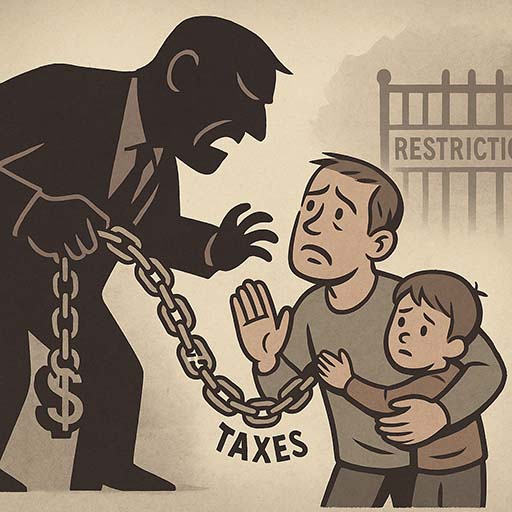
Untangle care from control
Two significant developments are converging in Australia’s ongoing debate about childcare: one in parliament, the other in the courts. Both raise questions not just about policy — but about fairness, freedom, and the evolving role of government in family life.
On one side, Prime Minister Anthony Albanese has unveiled a plan to expand the childcare subsidy to families earning up to $530,000 a year. From January 2026, all eligible families will receive at least three days of subsidised childcare per week, regardless of how much they work or study. It’s a step toward universal early education — a move Labor frames as a social equaliser.
But a deeper legal challenge is now emerging. The law firm Arnold Bloch Leibler is preparing to contest a decades-old rule that stops parents from claiming childcare fees as a tax deduction. This rule stems from a 1971 High Court decision that declared such costs “private” and not tied to the earning of income — a position that now feels increasingly out of touch with the structure of modern working families.
If the state truly acknowledges that childcare allows parents to work and contribute to the economy, then denying them a tax deduction for childcare expenses is a glaring contradiction. Even if the current legal challenge succeeds, many families may still be excluded from benefiting because they have elected to receive government-paid childcare subsidies, subsidies which come with strict conditions and limitations. Offering a tax deduction would break those constraints, granting families greater freedom and fairness in how they manage childcare costs.
Conditional Generosity: The Vaccination Requirement
While the policy shift toward more subsidised care may sound generous, it’s important to note the conditions attached. To receive the Child Care Subsidy (CCS) — now or under the 2026 model — a child must be fully immunised, be on a catch-up schedule, or have a valid medical exemption. The government’s “No Jab, No Pay” policy explicitly excludes families with philosophical or religious objections to vaccination.
Regardless of your views on vaccination, this creates a coercive dynamic, where financial assistance for early education is offered only to those who comply with a particular medical intervention — regardless of personal, ethical, or cultural beliefs. For families who decline vaccination on conscientious grounds, the policy effectively withholds public support for childcare — even as it claims to promote equality.
How a Tax Deduction Can Widen Access To Childcare
Here’s where the court challenge becomes especially relevant. A tax deduction for childcare expenses — unlike the subsidy — would not be conditional.
That means:
• Families who are currently ineligible for subsidies due to their child’s immunisation status could still benefit from a tax-deductible work expense.
• Families who earn too much to qualify for Family Tax Benefit A or B, or who have opted out of the subsidy system altogether, could still offset childcare costs through their tax return.
• Unlike a subsidy, which is administered upfront and subject to eligibility criteria, a deduction operates post hoc and is neutral to personal health decisions.
In other words, a tax deduction would restore a measure of financial fairness for those excluded under the current regime. It would recognise that childcare is often an unavoidable cost of earning a living — not a lifestyle choice — and that families of all backgrounds deserve to be treated with dignity under tax law.
Critics warn that tax deductions favour high-income households, but this is a question of policy design, not principle. A just tax system can be progressive and inclusive without being punitive to those who step outside government-approved behaviours.
Who Really Benefits? Questioning the Opposition to Childcare Tax Deductions
While the legal challenge to allow childcare fees as a tax deduction gains momentum, not everyone agrees it’s a good idea. The Grattan Institute, a well-known, governmentally think tank, has voiced strong opposition, arguing that most families—including low-income households—would be worse off under such a change compared to the current subsidy system.
However, this raises an important question: Why does the Grattan Institute oppose a tax deduction that could help many families, including those excluded from subsidies due to vaccination rules or income thresholds? Is it purely based on economic forecasting, or might there be other interests at play? After all, public policy should be guided by fairness, transparency, and respect for family autonomy—not by hidden agendas or ideological biases.
Laws and policies must align with justice and the common good. If denying tax deductions for childcare aids in the continuation of inequality or punishes parents who don’t fit the government’s preferred mold, then such opposition deserves close scrutiny.
In the end, the debate is about more than dollars and cents — it’s about whether Australia’s laws fairly serve all families, or only those who conform to specific government criteria.
In the name of fairness, the law must recognise that for many parents, childcare is not a luxury — it’s essential to survival in a two-income economy. Whether through subsidies or tax treatment, governments should support families without coercion and without tying essential services to compliance with mandates.
In a free and just society, help should come without strings. The debate over childcare tax deductibility is more than a question of finance — it’s a test of whether Australia is willing to untangle care from control.
Written by John E Middleclass

July 2025