
Can Society Have Rights, or Do Rights Only Belong to Individuals?
Rights are generally understood as entitlements or freedoms that individuals possess — the right to life, liberty, freedom of speech, and property rights.
But who grants such rights? Is it a nation-state or a creator?
Did we discover these rights through scientific methods, or did we concoct them in a courtroom? And what happens when people and governments allow rights to flourish — or when they restrict them through political power?
(political power is the legal privilege of using force on persons who have not harmed anyone)
Our understanding of human rights and the laws that protect them has been shaped over centuries. Great thinkers have long argued that rights and laws can be studied like the laws of physics or chemistry.
Thomas Paine once wrote:
“Man cannot make principles, he can only discover them.”
John Quincy Adams, the 6th president of the United States was quoted as saying: “Our political way of life is by the laws of nature, of nature’s God, and of course presupposes the existence of God, the moral ruler of the universe, and a right and wrong preceding all institutions of human society and of government”.
After WW2, at the Nuremberg trials, Nazi defendants claimed innocence of wrongdoing because they were following their country’s laws and legal orders. The prosecution argued that “there is a higher duty” than anything our governments can impose on us. The judges agreed: “The fact the defendant acted according to the order of his government or of a superior shall not free him from responsibility”. The defendants were executed on the admission of a higher law than any government’s law and all people are obliged to obey these higher laws.
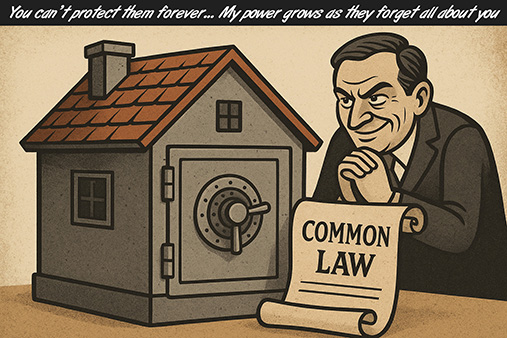
Laws and rights existed before, and outside governments. Rights belong to human beings, not to “society.” Human beings have used reason and observation to discover and codify what we call Natural Law, Common Law, or God’s Law.
Society may benefit from these rights, but as Margaret Thatcher once said: “There is no such thing as society.”
She went on to explain: “There are individual men and women, and there are families. And no government can do anything except through people, and people must look to themselves first. It’s our duty to look after ourselves and then to look after our neighbour.”
Sadly, the ideas championed by thinkers like Thatcher and Paine are vanishing — replaced by left-wing–captured universities and political think tanks. We are surrounded today by “woke” ideas that put the group above the individual. Words like community stakeholder, social capital, and society are treated as the highest values — as if personal freedom, creativity, and responsibility should be given up to fit in with everyone else.
Friedrich Hayek, one of the leading classical economists, once said: “Society is a term deployed when people do not quite know what they are talking about.”
Today, “Society” is used as a vague, feel-good label to blur personal responsibility and hide the reality that only individuals can think and act rationally.
Charles Mackay once wrote: “Men think in herds; it will be said that they go mad in herds, while they only recover their senses slowly, and one by one”.
The Foundations of Freedom
Under Natural, God-given, and Common Law, individuals are the rightful holders of freedoms that both precede and outrank political laws.
The principles of Common Law — rights to life, liberty, property, and the presumption of innocence — grew from a Christian understanding of natural justice and the equal worth of every person before God.
Woke culture rejects these foundations and desperately aims to eradicate all virtues relating to Western society, Common law, and Christianity. It elevates the collective above the individual, placing certain minority groups on a pedestal while undermining the moral framework that has protected freedom for centuries.
‘Wokeism’ appeals to political powers to impose conformity, often using the courts to silence dissent. In short it is communism by a different name.
It is no accident that woke ideology aligns itself with global corporate giants intent on building monopolies with state assistance. This parasitic relationship works to weaken nations, destabilise gender norms, undermine the family unit, slander Western heritage, and erode true bible based Christianity.
Ancient Laws Under Attack
This is not merely a cultural dispute; it is a direct assault on the laws and moral order that have preserved liberty for generations.
The battlefield is now set for a showdown between two legal worlds: modern political laws, designed to expand state control, and the ancient Natural and Common Laws, which affirm that our rights come not from governments, but from God and are observable in nature.
Author Richard J. Maybury distilled these ancient laws into just two simple principles:
1. “Do all you have agreed to do” — the foundation of contract law, where agreements made without force or deception are binding.
2. “Do not encroach on other persons or their property” — the basis of criminal and tort law.
When individuals, governments, and corporations respect and uphold these principles, societies prosper—attracting capital, fostering innovation, and improving quality of life. But when these principles are ignored or trampled, the results are stark: economic decline, poor health outcomes, social unrest, and stagnation. You can track and measure these results. Look at countries that tax citizens too much, or place them in debt through the use of force. Quality of life declines. When you stifle ownership and the right to freedom of speech and beliefs, you stifle innovation and investment. Capital will flee.
This isn’t just theory. It applies equally to businesses as it does to governments and individuals. Yet many corporations today are caught up in woke ideology, throwing in their lot with the opponents of Common Law by abandoning respect for the individual and imposing political agendas that alienate and divide the very people whose freedoms and choices underpin their success.
Go Woke Go Broke
American Eagle Outfitters’ push of social justice messaging alienated everyday shoppers and caused stock prices to plummet. Only recently did they return to a more traditional approach, casting Sydney Sweeney in a simple jeans ad. Despite the campaign boosting their stock by a remarkable 20%, backlash from some woke commentators forced the company to pull the ad. It appears their leaders prioritise virtue signalling over shareholder value.
Consider the US beer brand Bud Light’s campaign featuring a trans activist—it broke the unspoken contract with its customer base, resulting in billions lost in sales and market value.
Gillette’s “toxic masculinity” ad similarly lectured its core customers and wiped out more than $8 billion in brand value. Even Disney has faced intense backlash for politicising children’s entertainment. These are more than marketing missteps; they are breaches of the core contracts that underpin trust between businesses and individuals—the very contracts Maybury described. People may not always find the words to express it, but they know their rights are under attack. They recognise that the brands they once supported are now, whether deliberately or not, working against their interests—and they don’t like it. As a result, they have rightly boycotted these companies to defend their freedoms.
Can society possess rights, or do rights belong solely to individuals?
History, philosophy, and law answer without hesitation — rights belong to individuals. They are God-given, natural, and timeless, discovered through reason and codified in Common Law, not granted or revoked by shifting political winds or collective ideals. Today, woke ideology seeks to overturn this fundamental truth. It demands loyalty to an amorphous “society” at the expense of the individual. But this is not merely a battle over ideas; it is a fight for the very foundation of liberty, for the moral and legal order that has sustained Western civilisation for centuries.
When corporations and governments abandon respect for individual rights, they break the social contracts that built the prosperity and freedom they enjoy.
The erosion of these rights leads not just to economic and social decline, but to the slow death of a free society.
Now, more than ever, it is our duty to stand firm on the principles of Natural and Common Law — to insist that rights belong to individuals, not to vague collectives. To demand governments and businesses to do the same.
Written by John E Middleclass.

Chitchat Newspaper. September 2025.