
MAD SCIENCE
Science used to be… respectful—a careful search for truth, a slow uncovering of nature’s secrets. Now it’s morphed into a reckless carnival of glowing cats, pig-me people, Benjamin Button rodents, and DNA splicing across species because, well… who says they can’t?
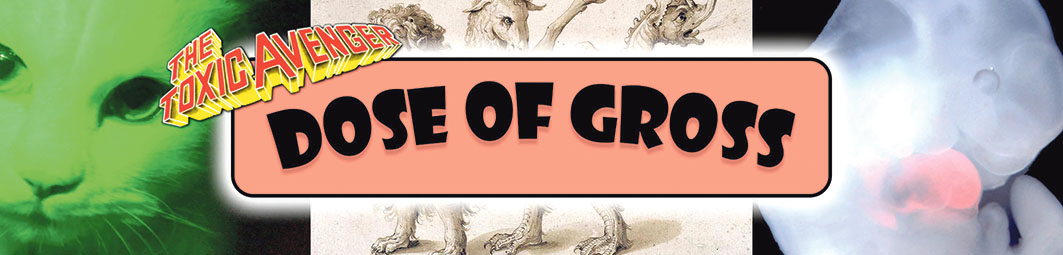
This month’s dose of gross zeros in on the mad scientists creating chimeras — morphing man and pig – Steve and Swine. Right now, human stem cells are being injected into pig embryos, CRISPR is used to scribble on their DNA like a graffiti artist, and foetal development is then killed or “neutralised” at 28 days. Voilà: Franken-pigs with a side of organ transplant potential. Admiring Greek Mythology is quaint. Building hybrid creatures that didn’t exist yesterday? That’s something else entirely.
What’s a Chimera, Anyway?
In biology, a chimera (ky-mee-ra) isn’t just a fire-breathing monster from Greek mythology—it’s an organism made of cells from two different species. Sure, nature has its own chimeras: a mother can benefit from cells of a child still in her womb, quietly borrowing what she needs. But what we’re looking at today is way beyond that quiet natural phenomenon. Inject human stem cells into a pig embryo, and suddenly you’ve got a patchwork of human and pig cells growing together in ways that were never intended.
Glowing Cats
You may remember the glow-in-the-dark chimeric cats back in 2007. Scientists at Gyeongsang National University cloned cats that glowed red under UV light. This was achieved by inserting a red fluorescent protein (RFP) gene from coral into the cats’ skin cells before cloning. This led to researchers at the Audubon Center for Research of Endangered Species in New Orleans to create a cat named Mr. Green Genes. He expressed a green fluorescent protein (GFP) gene from jellyfish throughout his body, making his eyes, gums, and tongue glow green under UV light. This experiment confirmed that the gene transfer technique was successful and heritable without cloning.
That man is a real pig…
In 2025, pigs took centre stage, making sci-fi writers jealous. Chimera Kidneys got FDA approval for broader trials. A US patient survived more than seven months with a pig kidney, ticking along nicely. In China, a gene-edited pig liver kept a patient alive for 171 days, filtering blood and producing bile like it had been trained for the job. Even franken-lungs—arguably the hardest organs to transplant—functioned for nine days in a brain-dead patient. Meanwhile, researchers are quietly growing human organs inside pig embryos, carefully skirting the nightmare of human-like brains while chasing the promise of tailor-made organs for actual patients.
Meet the Human-Winged Salamander Guy
Juan Carlos Izpisua Belmonte had spent years crawling through the inner machinery of embryos, chasing the genes that tell a body to make a leg here, a wing there. He tracked chemical messengers that, like traffic cops on a microscopic scale, direct cells to turn left or right. He’d tinkered with animals to grow extra limbs, turning life into something that looked like a biology-themed LEGO set. But salamanders haunted him—lose a limb, grow a perfect replacement.
Could humans do the same? Could they regrow a brain?
Let’s try…. Petri dish experiments turned into pig embryos spiked with human stem cells. Hearts, kidneys, placentas—he was building organs piece by piece, like some mad watchmaker with a blueprint that shouldn’t exist. He even set about reversing aging in mice, turning them into tiny Benjamin Buttons, fur and all. Perhaps, even pigs might fly. Wouldn’t that send the stock price of his company, Altos Labs, in the same direction!
Colleagues call him “fearless.”
Translation: terrifying.
Because in Belmonte’s world, the line between right and wrong isn’t blurry—it’s simply optional.
Ethics Deferred Is Ethics Denied
Fearless ambition doesn’t come with a morality switch. Scientists admit it’s theoretically possible pigs could develop human-like brains, then reproduce, or even grow a set of wings. Who knows what’s been hacked together in off-the-radar backyard labs?
Moral Foundations
We’ve spent centuries building moral scaffolding for moments like this: Natural law. God-given law. Magna Carta. English Common Law. The Bill of Rights. Human rights. Even in modern Australia, where political whims are slowly replacing tradition, these frameworks say: respect others, don’t mess with their property—including their bodies.
Does this apply to unborn children? When does life start? Should scientists have a right to meddle with DNA and unborn children?
With close to 5 billion people basing their morality on themes found in the book of Genesis, it may be worth taking a look… (Jews, Christians, and Muslims are known as Abrahamic religions)
Genesis 1 states that life was created “according to its kind.”
The vegetation on the third day, according to their kinds, the creatures of the waters and winged creatures on the fifth day, according to their kinds, the living creatures according to their kinds: livestock, land crawlers, and beasts of the earth according to their kinds on the sixth day.
It is interesting to note that there was no mention of humans being created according to their kinds.
Genesis simply states that “God created man in His own image; in the image of God He created him; male and female He created them” (Gen 1:27).
People instinctively feel something is off when humans start mixing themselves with pigs in the lab. Many also feel uneasy when they hear about Monsanto’s franken-seeds and genetically modified organisms for food. It is disturbing to consider the future possibilities of science, medicine, and what the ancient Greeks knew as pharmakia (sorcery) when ethics are left by the wayside.
Science is sprinting. Ethics are seen as a nuisance and a roadblock to progress. Belmonte and his fearless cohort marvel at the potential.
The rest of us are left staring at lab-grown nightmares and asking the same question Mary Shelley whispered through Frankenstein: just because we can, does it mean we should?
Written by Frank Ian Stine Jr.
Chitchat Newspaper. January 2026.