
Have you ever stopped to wonder how the device in your hand connects you from a farm in Apple Tree Creek to a Temu warehouse in China? Technology today is frighteningly advanced and remarkably cheap… when you think about what is actually happening behind the scenes.
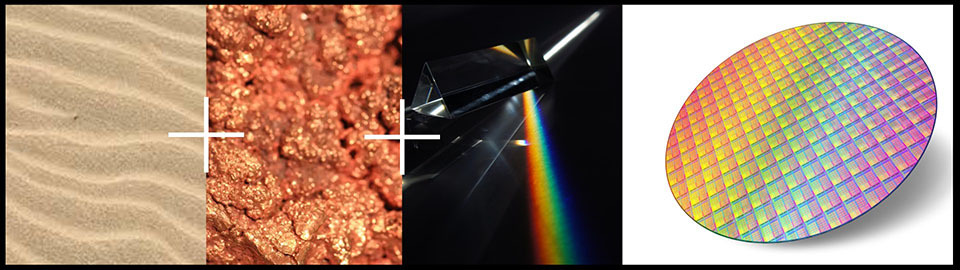
Some might say that it’s as simple as sand, copper, and light.
Well, maybe in Minecraft.
Strap yourself in and let’s take a look at our remarkable microchips and the way we communicate around the region, and around the world.
At the press of a button, calculations are made, and information races away as electrical signals and flashes of light through fibre-optic cables, travelling at nearly the speed of light. Even though many people imagine the internet as signals bouncing through space or off satellites, more than 95% of global internet traffic actually moves through wires, including huge undersea cables connecting Australia to the rest of the world.
Because of this network, people around Bundy can instantly share Instagram snaps in front of the barrel or spotting the turtles.
We can live-stream videos of the performers at the Childers festival, and use smart technology in schools, farms, and hospitals. It has become so ingrained in everyday life that we really do take it for granted.
Inside your smartphone or computer are tiny but incredibly powerful microchips. One phone alone can contain dozens of chips with billions of transistors, which are microscopic switches that help computers think, calculate, and remember. Even though these chips are no bigger than an ant, they are made using one of the most complex manufacturing processes on Earth.
Microchips are built in special buildings called semiconductor fabrication plants, or “fabs.” Inside a fab is a giant cleanroom—so clean that dust particles are a serious enemy. These cleanrooms can be as large as eight football fields and are filled with hundreds of machines that can cost millions (or even hundreds of millions) of dollars. Why so fancy? Because even a tiny mistake can ruin an entire chip.
The main ingredient for chips is silicon, which comes from sand. Silicon is formed into thin, round discs called wafers. Each wafer is about the size of a dinner plate and can hold hundreds of chips at once.
Over about three months, each wafer travels from machine to machine, going through nearly 1,000 steps to build a chip layer by layer.
You can imagine making a chip like baking an extremely complicated cake with about 80 super-thin layers. Each layer has a unique pattern and must line up perfectly with the others. To do this, engineers use a process called photolithography, which works a bit like using a stencil. A light-sensitive coating is spread on the wafer, ultraviolet light shines through a detailed pattern, and chemicals wash away certain areas to leave behind a tiny design.
Once the pattern is in place, machines either add material, remove material, or change the silicon itself. Metals like copper are added to create wires that carry electrical signals. Other machines etch away material to form tiny paths and holes. Special tools change the silicon so it can form transistors, which act like on-and-off switches for electricity. Between almost every step, the wafer is carefully cleaned and inspected to make sure everything is perfect.
Microchips are manufactured all around the world. Taiwan is the most famous producer, home to some of the largest and most advanced chip factories on the planet.
South Korea is another major chip-making country, especially for memory chips. The United States, Japan, and parts of Europe also have important fabrication plants. Costa Rica plays a key role too, especially in chip testing and assembly. Together, these countries form a global network that keeps modern technology running.
After all the layers are complete, the wafer is tested. Not every chip works perfectly, so engineers sort them based on how well they function. Then, lasers cut the wafer into individual chips. Each chip is packaged, protected, and tested one last time before it’s ready to be installed in computers, phones, and game consoles.
In the end, making a microchip takes huge machines, extreme precision, and lots of patience. It’s a powerful mix of science and engineering, packed into a piece of technology small enough to fit on your fingertip. What makes this even more impressive is how far we’ve come—from the first simple transistors and basic binary systems to today’s chips that can perform billions of calculations every second.
Now, whip out your phone and share a poop emoji with your spouse…. Just to show how technologically advanced we’ve become as a society.
Scan the QR code to watch the manufacturing process on Youtube.

Chitchat Newspaper. February 2026.