
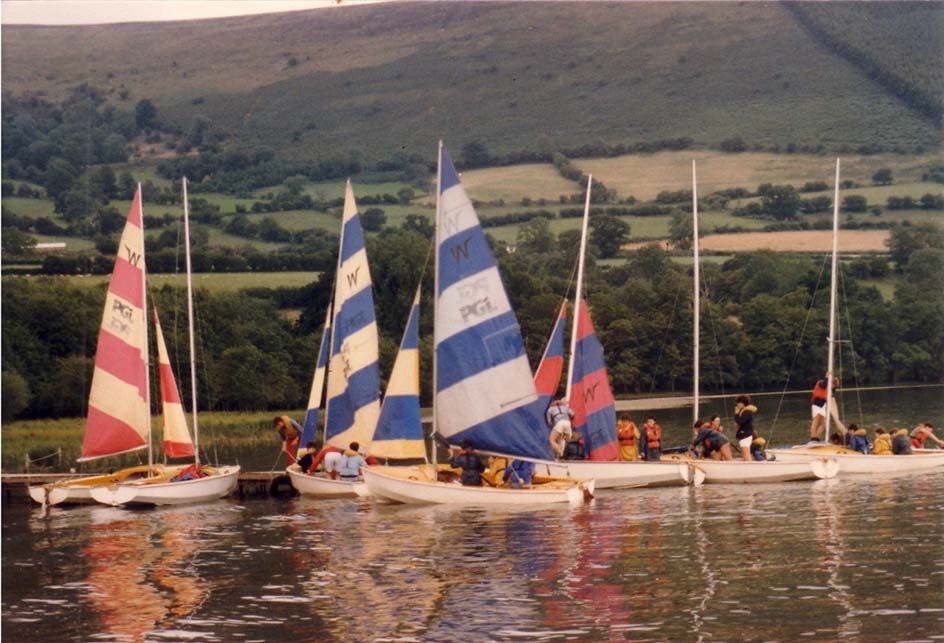
Amid the myriad of experiences that make us who we are, there are some that stand out. Significant for numerous reasons, these are the ones we remember the most, the ones that shape us. For me it was learning to sail, and I can still remember my very first sailing experience.
I was in primary school in the U.K. when our headmaster, a member of the local sailing club, started a sailing program. There were only six of us to start with, as that’s all that could fit in the station wagon! And our first voyage on the water was in a Skipper, a small keel yacht. I remember going to bed that night, still feeling the gentle movement of the boat and the sound of the water as it rippled along the hull.
Sailing was an activity that I instantly fell in love with. Whether it was the motion through the water, the simple action of wind upon sails, the proximity to the natural environment, or the feeling of wind in my hair, I was hooked and eagerly anticipated our next lesson.
Over consecutive weeks we sailed in GP14s, then graduated to Cadets, small sailing dinghies that we helmed and crewed by ourselves, watched on and encouraged by our headmaster in the rescue boat. We were even given junior membership to the sailing club, and I remember one weekend persuading my father to take my brother and I to the reservoir for an afternoon sail. But the wind was already up.
‘It’s a force four,’ the sailing master said. ‘Are you sure you can handle it?’
‘Yes.’ I replied, not confident at all. I was just desperate to get out on the water.
And all was going well, for the first thirty minutes, but as we sailed closer to the mark, and into the middle of the Saturday afternoon race, I thought it time to go about. But going about in the strong wind proved difficult, and the closer I came to the mark, the more I struggled. Then, finally we turned. ‘Well done!’ my elder brother called, a little too soon.
Just as we settled on the return tack, a sudden gust caught us and over we went! Of course we were wearing life jackets, and the water wasn’t cold, but the sudden capsize unnerved me. It wasn’t something we had previously practised! Shortly after, however, the rescue boat arrived and towed us ignominiously back to the shore. My father looked at us solemnly, but inwardly I smiled. It was another tale to tell.
Years later, while at university, I spent a summer teaching sailing at a summer holiday camp on Llangorse Lake in Wales. I earned very little money for my efforts, but had a thoroughly enjoyable time, and it was there that I became interested in the greater value of outdoor education. It was then that I came to realise that, apart from the fun and freedom of the sailboat, there were many other benefits. There was also plenty of excitement.
One grey day we were out on the lake, our Wayfarer dinghies filled to the gunwales with excited primary school children. They cheered and waved to their friends on the other boats, waving and smiling, oblivious to the incoming maelstrom that caught us all by surprise.
It happened very quickly.
One moment we were sailing gently along, the next – a fierce wall of wind, a meteorological anomaly, funnelled down the lake, catching us all off guard. I stared ahead as the other dinghies toppled like dominoes before us, capsizing one by one. Fortunately, as we were at the tail end of the fleet, I realised what was happening and let fly the mainsail. Then I reached forward and released the jib sheet from the panic-frozen grip of a child.
The boat instantly heeled over, water starting to pour over the gunwale into the Wayfarer’s deep hull. I leant with all my weight on the windward side, the sails loose and flapping, and somehow, despite the additional weight, the dinghy remained upright.
Then just as quickly as it had arrived, the hurricane disappeared, leaving a trail of wet and soggy sailors in its wake. Checking first that everyone was okay, I set to bailing out the water, thankful that we were still upright, and my reputation intact. But then a disappointed voice piped up.
‘Why didn’t we get to capsize?’
In case you’re wondering whether I may have been exaggerating about the force of the wind, our marquee on shore was ripped out of the ground, its four-feet long steel stakes pulled out!
The following year, as I started my teacher training on England’s south coast, I worked alongside a teacher, a former sailing instructor, who owned a small yacht, a Jaguar 27. On Wednesday afternoons he took several of the senior students sailing, teaching them the theory and practice of sailing, navigating, and preparing for an overnight passage. He was even allowed to take them on a weekend trip across the English Channel to France!
After joining them on several occasions, I realised that a small yacht is much like a classroom, and the lessons learned on board can be valuable life-lessons. It wasn’t just about the physics of wind and sail, but an opportunity for teamwork, communication, leadership. All in an environment that was challenging and very real.
Learning from this, I was keen to focus my teacher training beyond the classroom, to the broader sphere of Outdoor Education.
Serendipitously, just as I finished my Teaching course, I was fortunate enough to land a job on another summer ‘holiday camp’ but this time as a skipper on a yacht full of teenagers, sailing around the British Virgin Islands, in the Caribbean.
Imagine! After having only ever endured British ‘summers’, I was heading to the Caribbean – a sailor’s paradise, and a dream come true.
I was given the onerous responsibility of skippering a fifty-foot yacht, worth, I was informed, a mere $250,000, and it would be full of teenage boys. But, as is often the case, I was able to rise to the occasion and, in the company of more experienced staff, led my motley crew on an adventure of a lifetime. We sailed, raced, and cruised around stunning emerald islands surrounded by navy blue seas and clear blue skies, all in the legendary trade winds – perfect sailing conditions.
The sailing was one thing, managing teenage boys, however, was another thing altogether. Teaching them to live and work together for a month was a challenge in itself! But gradually, together, we learned to navigate the mini society that is a fully crewed yacht. And while it had its share of excitement and more serious moments, it was also a lot of fun. It was a unique experience, and one that I have never forgotten.
Now nearing retirement, I still enjoy sailing, mostly on Sydney’s glorious harbour and waterways.
Recently I joined the Making Waves Foundation (MWF), formerly Sailers With Disabilities, a charity organisation that runs various sailing programs all aimed at creating opportunities for young people to experience the joy of sailing and, importantly, to learn valuable life skills.
As a volunteer with MWF, I thoroughly enjoy the opportunity to give back, to be making a difference in the lives of young people, and to enjoy the company and community of other, like-minded people, old as we are!
These fabulous waterborne experiences have provided so many enjoyable memories, but more than that, they have all contributed to the person I have become, providing me with amazing opportunities and life-lessons.
Long may they continue!
Written by Clive Thomas.
Read more from Author Clive Thomas at:
www.clivethomas.com.au
Chitchat Newspaper. March 2026.