
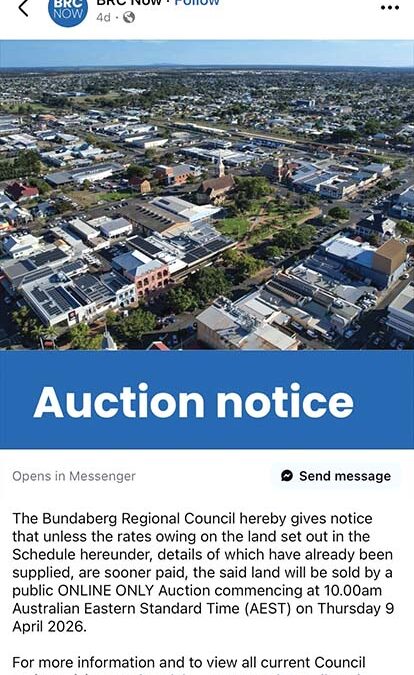
BUNDABERG COUNCIL TO AUCTION THEIR NEIGHBOURS’ HOMES
The decision by Bundaberg Regional Council to auction local homes over unpaid rates may be within the political law, but many locals are asking a tougher question: Is it ethical for the council to take their neighbours property, which they don’t own, and offer it to another?
The properties listed for auction, at 10:00am on the 9th of August, are ordinary homes and rural blocks in Bundaberg East, Millbank, Svensson Heights, Sharon, Moore Park Beach, and Waterloo. They are owned by local families and neighbours who simply didn’t pay council’s debt on council’s terms.
Unless the debt is paid in full, these homes will be seized and sold to strangers, wiping out the owner’s claim. The government has made this legal, which forces an unsettling question: if government can cancel your title over forced debts — and do so in the middle of a natural disaster — who really owns your home?
The Castle
For hard-working Aussies who value a fair go, ownership is the result of years of hard work, sacrifice, and creating your own “castle”. These accumulated debts in the form of rates and services were not voluntarily entered into; residents did not choose to get into them. Rates are imposed through the threat and use of force, with no opportunity to choose a competing service provider.
Perhaps that’s why the iconic Australian film The Castle resonates so deeply with Aussies across the country — it captures the simple, fundamental idea that a home is more than bricks and land; it is the heart of family, community, and a fair go.
If this reflects common popular opinion, how did we end up with a government so far removed from it?
Timing and Community Impact
The timing of this forced auction announcement is clearly out of step with popular opinion: it was issued while the region was grappling with devastating floods, with families struggling to protect their homes and locals facing enormous uncertainty. In times of disaster, communities expect compassion and flexibility.
Governments have flexibility to defer deadlines, suspend penalties, and focus on relief. To announce the forced sale of homes during such a moment feels, to many, profoundly out of step with that expectation. Even if the process had been underway for years, choosing that moment to proceed sends a clear message…
Is It Just?
Under Queensland law, councils have the political privilege to sell land when rates have gone unpaid for three years. Notices are issued, procedures followed, and the sale proceeds. On paper, everything is correct. Yet most Aussies agree there is a difference between what is legal and what is right. Aussies who value a fair go hold that certain rights exist simply because we are human. In fact, our Common Law in Australia is built on this understanding.
Chief among these is the right to own property. You work, you save, you build, you buy land, and it becomes yours. Government did not create that right; it existed prior to government. In fact, the very purpose of government was to protect it.
When a home can be taken and sold by the council over involuntary rates, it highlights that something has gone horribly wrong in our “free” society. From a natural law perspective, justice requires proportionality. The punishment should fit the problem.
Losing one’s home over accumulation of compulsory charges — especially when the debt is wildly disproportionate to the value of the property, feels wrong.
There is also a deeper concern. If the state can ultimately seize property for failing to pay taxes on it, do Aussies truly own their land, or are they merely renting it from government landlords? That question cuts to the heart of the Australian ideal of a “fair go”. Many people worked their entire lives to pay off a mortgage precisely so they would never again answer to a landlord. The promise was security. Stability. Something that could not be taken away arbitrarily. When forced sales occur — especially during a time of natural disaster — that promise looks uncertain.
The Monopoly of Council Services
Rates are often described as payment for services — roads, rubbish collection, drainage, parks, libraries. But unlike ordinary services, residents cannot opt out. You cannot hire another company to maintain the public road outside your home. You cannot choose a competing provider to collect your bins. Even if you privately arrange alternatives, the rates bill still arrives. In effect, local government operates as a monopoly backed by the threat of force. There is no ability to shop around, negotiate prices, or refuse the service while keeping your property. Payment is compulsory, and the consequences for non-payment can include the loss of the very asset being taxed.
Language Reform
The language used by Council is deceptive. This is not a normal commercial relationship. What council call a “service” could more accurately be described as a compulsory tax extracted under threat of property seizure.
Alternatives and Humane Enforcement
Councils are not powerless — they have discretion in how they “serve” their neighbours. Across Australia, many local governments offer alternatives: long-term payment plans, hardship provisions, interest relief, or deferred rates that are recovered only when the property is eventually sold.
A just system would exhaust every reasonable alternative before taking the ultimate step of selling someone’s land, even if they had the legal privilege of doing so. It would treat forced sale as an absolute last resort, paused when communities are in crisis.
Conclusion
None of this denies that councils require revenue to survive. But justice demands that consequences respect both the fundamental rights of Australians and the fact that they never had a genuine choice in the first place.
Ultimately, this issue is not about accounting. It is about the relationship between Australians and the institutions that hold power over them. If ownership can be erased over unpaid rates — for services people are compelled to accept, and pursued even while communities battle floods — then property rights exist only at the good pleasure of the government.
The current political law may allow these sales. But the community must decide whether they are truly just. If not… who serves who?
Chitchat Newspaper. April 2026.