
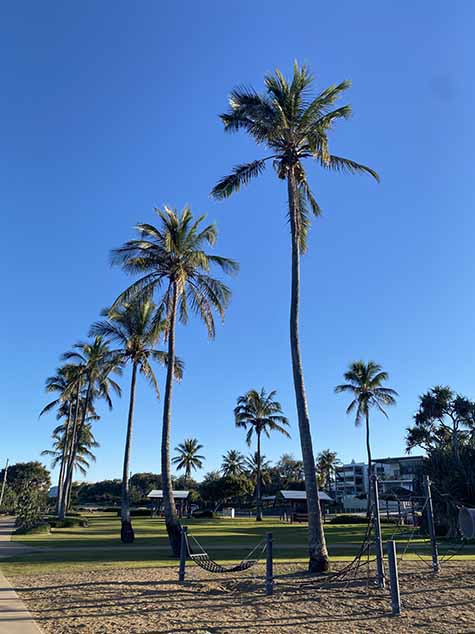
Coconuts in Bundaberg
While the rest of Australia huddles through months of frosty mornings and grey skies, here in Bundaberg we’re treated to a gentler kind of winter.
Sure, the mornings are crisp and the days shorter — but one glance at the coconut palms lining Bargara or Woodgate Beach and it’s clear: we’re still living in a tropical paradise.
It’s easy to forget how blessed we are. The rustle of the fronds in the sea breeze, the warmth of the sun on your skin by mid-morning — these are small daily reminders that a Bundy winter is about as inconvenient and short-lived as a butt dial. Nowhere is this more obvious than in the presence of the coconut palm, a tree that wouldn’t survive a truly harsh winter. Like us Queenslanders, it simply wasn’t made for the cold.
Coconut palms need warmth, sunlight, humidity, and rain — not frost or snow. They thrive when summer temperatures stay between 28 and 37 °C, and struggle when winter drops much below 12 °C. A hard frost? That’s fatal. The coconut palm’s very survival in our region is proof that, while the calendar might say July, the tropics are never far away.
A Symbol of Resilience — and of Home
Bundaberg’s palms aren’t just decorative. They’re a symbol of something deeper: tropical resilience. They weather gale-force storms and cyclones. They grow tall and bend without breaking. They stand watch over our coastlines, and in winter, they remind us — this too shall pass.
But the coconut palm is more than just a pretty face, or head for that matter…. (The name coconut is derived from the 16th-century Portuguese word coco, meaning ‘head’ or ‘skull’ due to the three indentations on the coconut shell that resemble a face)
There’s a fascinating and ongoing debate about its place in Australia. Some researchers argue coconuts are foreign visitors, brought here by human hands. Others believe they’ve had a longer natural presence, arriving on ocean currents or even thriving in earlier climates long before Europeans set foot here.
Deep Roots: Coconuts in Queensland’s Past
One of the more intriguing chapters of our coconut story lies in North Queensland. Researchers like Buckley and Harries (1984) documented wild coconut types on remote islands of Australia, coconuts with thick husks (niu kafa), shaped by nature to travel long distances across the sea. These are different from the round, cultivated coconuts we plant today (niu vai), which rely on human hands for spreading.
Fossilised coconut fruits found in Queensland’s Chinchilla area suggest that coconut-like plants were here thousands of years ago during warmer, wetter ages. And some believe Aboriginal people used coconuts before European contact, though the evidence remains sparse and debated.
It is interesting to note that Joseph Banks, the famous botanist who sailed with Captain Cook on the HMS Endeavour, described coconuts as part of the flotsam that he found on the banks of the Endeavour River (Beaglehole 1962):
[1 July 1770]: ‘our second lieutenant found the husk of a cocoa nut full of barnacles cast up on the beach; probably it had come from some island to windward, from Terra del Espirito Santo possibly as we are now in its latitude’
[5 July]: . . . walked along a sandy beach open to the trade wind. Here I found innumerable fruits many of plants I had not seen in this country, among them were some Cocoa nuts that had been open’d (as Tupia told us) by a kind of crab called by the Dutch Beurs Krabbe (Cancer latro) that feeds upon them . . . all these fruits were encrusted with sea productions and many of them covered with Barnacles.
Whether our beloved coco’s are natural travellers or human imports, coconuts have a long relationship with this land and its people.
“A Heritage For Our Children” — Bundaberg’s South Seas Legacy
“He who plants a coconut tree plants food and drink, vessels and clothing, a home for himself, and a heritage for his children.” — South Seas Proverb
This beautiful proverb is more than poetic, it’s personal. It speaks to the coconut’s unmatched usefulness, but also to something deeper: a legacy passed down, a life sustained. And for the Bundaberg region, it echoes even louder.
This region was shaped by generations of South Sea Islanders, many brought here as indentured labourers to work the sugar fields. Known as Kanakas, their knowledge, culture and agricultural expertise helped build the industries that Bundaberg still relies on today. The coconut tree, central to island life, is here to stay as a living tribute to their contribution.
The Tree That Gives Everything
Few plants are as generous as the coconut palm. Its fruit provides sweet, sterile water — nature’s original sports drink. The soft white flesh is packed with protein, fibre, and healthy fats. The husks become rope or mulch. The hard shell becomes bowls and tools. The fronds can be woven into baskets, fans, or roofing thatch. Even the trunk is strong enough to build homes.
In a way, the coconut is a perfect metaphor for the Bundaberg region — diverse, adaptable, hardworking, and full of life. Like our farms, our coastline, and our communities, it provides and sustains in quiet, powerful ways.
Let the Coconut Remind You: Winter Is Not Forever
So next time you feel the chill creep in and find yourself grumbling about winter, look to the palms. Let their swaying silhouettes along the coast remind you that you live in one of the most enviable climates in the country.
Let the coconut, with its long history, deep roots, and endless uses, remind you that up here, winter is brief and the sun still shines.
The tropics are still here. All you need to do is step outside, look up, and don’t forget to watch your head.
July 2025