
Welcome to the very first edition of the Dose of Gross
— the column that wades knee-deep into the slimy side of science so you don’t have to.
While the mainstream press is busy arguing over plastic straws, political tomfoolery and Taylor Swift sightings, the labs of the world are quietly rewriting what it may mean to be human — one creepy experiment at a time.
This month’s theme? Nature, hacked.
The Elbow That Could Get You Pregnant
At Oregon Health & Science University, researchers have officially turned human skin cells into eggs.
Not pretend ones — real, fertilisable oocytes that reached early embryo stages. It’s called in vitro gametogenesis, which basically means baby-making in a blender.
Here’s how it works: take a skin cell, rewind it into a stem cell, then nudge it down the egg-making, or sperm cell path, as not to be sexist…
The result? A cell that might one day grow into a person. Same-sex couples could both be genetic parents, and sex could become obsolete — not because anyone’s lost interest, but because mad scientist have no time for that. Stanford bioethicist Henry Greely predicts that in 20–40 years, “natural” conception might be frowned upon altogether. Parents will simply hand over a skin sample, get 100 embryos to choose from, and pick the healthiest or most attractive.
Because nothing says romance like swiping right on your future kid’s DNA.
Brains in Jars, Playing Pong
Meanwhile in Melbourne, researchers at Cortical Labs have grown living brain cells on silicon chips. The neurons were taught to play Pong — yes, the 1970s computer game — by giving them electrical feedback when they hit or missed the ball. They call it DishBrain. The cells come from reprogrammed blood, meaning your next brainchild might literally start in a test tube. The company’s latest version, CL1, is now being sold commercially as “biological computing.” It’s the first real attempt to make AI that thinks organically. But if those neurons ever learn to complain about their conditions, we’re going to have some explaining to do.

The Original Franken-Dogs
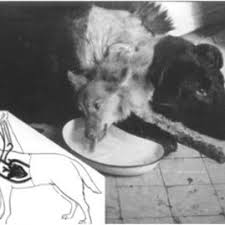
Of course, today’s “biological innovation” has nothing on the Soviets. In the 1940s, they were keeping decapitated dog heads alive — ears twitching, tongues licking, even reacting to sound — all to prove life could be restarted. It’s the granddaddy of gross science, the kind of stuff that would make even Frankenstein gag into his beaker.
Fast-forward 80 years and it seems we’ve learned nothing. We’re still convinced we can control, copy, or outsmart God — only now we use sterile gloves and university grants instead of vodka and dog parts.
The Gospel According to Elon
No modern science freakshow would be complete without Elon Musk. His company Neuralink has begun implanting chips into human brains, starting with a paraplegic patient who can now move a computer cursor by thought alone. It’s being sold as a triumph for the disabled— but Musk’s long-term vision is far bigger. He’s talked openly about “merging humans with AI,” uploading consciousness, and making the brain “future-proof.” In other words: defeating death with data. Maybe one day you’ll get a software update instead of a funeral. But here’s the question nobody’s asking: if we copy our thoughts into a chip, does that make us immortal — or just replace us with a smarter, colder imitation?
Nature 0, Hubris 1
From artificial reproduction to artificial intelligence and artificial resurrection, everything we’re building points to one goal — circumventing the natural world.
We’ve gone from Frankenstein’s monster to Frankenstein’s start-up. The sales pitch has just changed: “It’s not mad science — it’s innovation!”
Until then, I’ll keep scratching my head in disbelief, but please keep your dandruff cells to yourself — you never know what some scientist might grow out of them next.
Written by Frank Ian Stine Jr.
Chitchat Newspaper. November 2025.