
“I’m Just Trying to Survive”
Bundaberg disability pensioner facing court for selling fruit says complex council rules and strict enforcement make it almost impossible for small roadside vendors to earn a living.
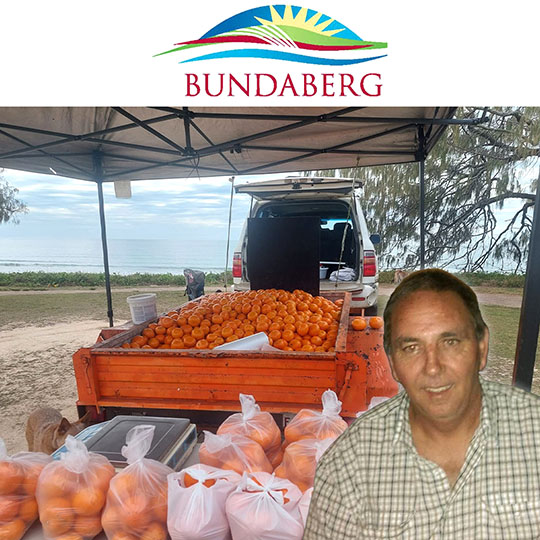
For more than 20 years, Raymond Aitkin has sold cheap mandarins, melons and seasonal fruit at roadside spots across the Bundaberg Region. What began as a way to supplement his disability pension and give purpose after past struggles with addiction has now placed him at the centre of a long-running dispute with Bundaberg Regional Council.
Mr Aitkin has been taken to court twice for operating without approval, most recently for selling citrus at Woodgate Beach. His matter has been adjourned for a hearing in February, as previously reported by ABC Wide Bay.
Raymond told the Chitchat that in court, he repeatedly told the magistrate that he did not believe he was breaking any meaningful law. “I’m not guilty of selling drugs,” he said. “I’m selling mandarins, very cheap mandarins, too.” He pleaded not guilty to the charge. Mr Aitkin claims he is the only roadside vendor in the region who has been repeatedly fined or prosecuted, despite what he says is the common practice of other stalls operating at Woodgate, Childers and along the Bruce Highway. These claims have not been independently verified.
“It’s a witch-hunt”: Aitkin’s claims of targeted enforcement
He alleges that council officers have visited him for years, sometimes asking him to move on and at other times issuing fines. He also describes one incident in which two officers asked whether he would sell fruit to them at a cheaper price. After declining, he says he received a $774 fine shortly after.
Mr Aitkin believes Bundaberg Council is deliberately targeting him, a claim council has not responded to, and estimates the enforcement effort has cost ratepayers “tens of thousands of dollars,” though this figure has not been confirmed.
Raymond alleges that:
“They showed up the first day of court with a troop of 8 employees, all arriving in different cars. The second day, there were five council workers, and again, they showed up in different cars. Again, the third day, there were 3 workers at court, all in different cars. I have never seen a council waste so much money on a little fruit stall that makes hardly any money. Some days I sit all day on the road to make $60”.
Council rules: a complex system that shuts out most small vendors
Bundaberg Regional Council’s own roadside vending guidelines show that selling fruit legally on a roadside stall is far more complex than many residents may realise, especially those with a disability.
Under council’s policy:
• All roadside vending requires an approval under Subordinate Local Law 1.2.
• No vending is allowed in council parks or reserves unless council specifically calls for tenders.
• Vendors must also comply with the state’s “Roadside Vending on State-Controlled Roads” guidelines.
• The approval process can take up to 30 days, with further delays if more information is required.
In addition, the region is broken into three regulatory zones, each with distance requirements that prohibit roadside vendors from operating near “competitive businesses”.
Some locations are entirely off-limits, including main roads with speed limits of 80km/h or higher, high-traffic roads, or any location where customers would need to stop in a kerbside lane.
To apply for a permit, vendors must submit:
• a detailed site plan
• a list of goods
• their operating days and times
• vehicle details
• proof of $20 million public liability insurance
• waste disposal plans
• signage details
• an application fee, followed by weekly, monthly or annual licensing fees
Council’s documentation states that roadside vending must not impede visibility, create environmental nuisances, affect traffic flow, or negatively impact roadside land.
Aitkin says the system effectively bars people like him
Mr Aitkin says that despite trying to get a permit, he was told approvals were not issued for selling produce in parks and gardens —He then reminded the council that he previously operated in some of those locations without issue for years. He argues that the multiple conditions, location restrictions, and insurance requirements make obtaining a permit unrealistic for small, low-income vendors. He says his attempts to meet with the mayor and relevant council staff to discuss alternatives were unsuccessful. He claims that after moving to private property, with a local landholder’s permission, council warned him and the property owner that they could be fined.
The Chitchat reached out to Bundaberg Council for a statement on this aspect of the dispute. Council emailed back stating that they are “unable to comment as the matter is currently subject to legal proceedings”.
A personal mission shaped by hardship
Beyond the legal battle, Mr Aitkin says his stall is more than a business. He describes selling fruit as part of his recovery from addiction and a way to support others doing it tough.
Over the years, he says he has:
• given away fruit to people experiencing homelessness
• provided free water during heatwaves
• donated produce to Meals on Wheels
• been robbed multiple times but continued trading
“I know what it’s like to live on the streets,” he says. “Selling fruit gives me a reason to get up in the morning.”
A broader question about fairness and access
While council has emphasised compliance with local laws in previous proceedings, Mr Aitkin’s case highlights a broader tension: how small vendors, particularly people with low income, disability, or limited legal knowledge, navigate a regulatory system involving:
• multiple laws
• multi-stage approvals
• strict location rules
• insurance requirements
• fees
• and up to a month-long processing time
For someone like Mr Aitkin, who operates with minimal resources and earns a modest daily income, these hurdles can be difficult or impossible to meet.
His case resumes in February, when a magistrate will decide whether he breached local laws by trading without a permit.
Chitchat Newspaper. December 2025.