
THE DEALS ARE FLOWING ON THE BIG ISLAND OF HAWAII
It sounds improbable, yet entirely possible for an Australian to purchase land in Hawaii for the price of a second-hand car.
On the Big Island—officially known as Hawaii Island—acres of land are currently being advertised from as little as $9,000 USD (around $12,500 AUD), with some ocean-adjacent lots around $14,900 USD (approximately $21,000 AUD).
These are not gimmicks. They are legitimate titles to real land in one of the most geographically unique regions in the world.
There’s an old saying in property: “Buy land—they’re not making any more of it.”
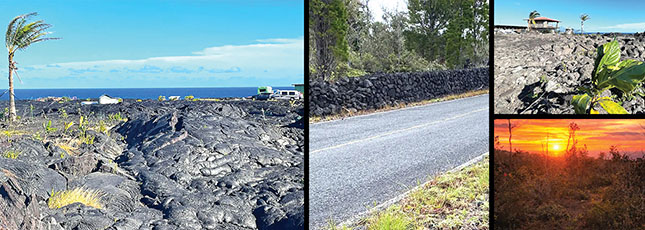
On Hawaii’s Big Island, that logic doesn’t quite hold. Here, the ground is still being formed. Lava from Kīlauea has, over time, pushed the coastline outward—quite literally creating new land. It is one of the few places on earth where supply is not just finite, but occasionally expanding.
In practical terms, while most of the world competes over real estate, Hawaii is one of the few places quietly adding to it.
One such offering sits near Kalapana, an area dramatically reshaped by volcanic activity over many decades. Former landmarks like Queen’s Bath and Waiaka Pond now exist more in memory than on a map, covered by successive lava flows through the 1980s to as recently as 2014. Yet appeal remains—one acre, ocean views, peaceful trade winds, and proximity to small local shops in Pahoa, just a short drive away.
Further south, in Hawaiian Ocean View Estates, a one-acre parcel at a similarly low price offers a different proposition: elevation, scenic coastal views, and access via sealed roads, albeit with typical off-grid expectations. Water is generally sourced through rain catchment, wastewater managed via septic systems, and electricity—if available—may require additional connection costs or independent solutions.
For Australian buyers, the good news is that it is entirely legal to purchase land in the United States. No blanket restrictions prevent foreign ownership of property in Hawaii. However, legality does not remove complexity. Buyers must remain aware of U.S. tax obligations, local county regulations, and ongoing compliance. Professional advice is a must.
Financing presents an immediate hurdle. In higher-risk areas of the island, particularly Lava Hazard Zones 1 and 2, access to conventional lending is extremely limited. You should assume that purchases will need to be made in cash. This lack of financing availability is a primary reason prices remain so low relative to other parts of Hawaii.
(Imagine the price of Australian real estate if banks didn’t expand the money supply with each new home loan.)
The zoning system itself is central to understanding both the risk and the pricing. The U.S. Geological Survey categorises the island into nine lava hazard zones based on proximity to active volcanic systems, including Mauna Loa and Kīlauea.
• Zone 1 represents the highest risk, covering active summits and rift zones.
• Zone 2 includes downslope areas that have historically experienced significant lava coverage—estimated between 15% and 25% since 1800.
• Risk decreases progressively through to Zone 9, which includes areas around Kohala, a volcano that has not erupted in many years.
This classification has practical consequences. Insurance can be difficult or costly to obtain in higher-risk zones, with some property owners relying on the Hawaii Property Insurance Association as a provider of last resort. Building is still permitted in these areas, but requires adherence to county regulations, including approved septic systems. While unpermitted structures do exist, they carry clear limitations regarding legal connections to utilities and insurability.
Environmental considerations extend beyond lava. Residents may experience “vog”—volcanic smog containing sulfur dioxide—which can pose health risks depending on conditions. Infrastructure can also be disrupted. In the event of a lava flow, access roads may be cut off, and while legal ownership of the land remains intact, practical use of that land may be significantly altered.
For readers in the Bundaberg and Childers region, much of this landscape will feel familiar. The climate sits at a comparable latitude to coastal Queensland, just in the opposite hemisphere. Warm temperatures, coastal breezes, and the ability to grow crops like sugarcane and macadamias will have you feeling right at home.
Australia exported the macadamia tree to Hawaii, where it became a commercial success. Hawaii, in turn, sent the cane toad in the opposite direction—an exchange that has aged better for one side than the other. Both places also share a connection to Captain James Cook, whose voyages linked Queensland with Hawaii. Personally, I think he liked Australia better; things didn’t end so well on his last trip back to Hawaii.
In Bundy and Childers, new land arrives slowly—through rezoning, subdivision approvals, and the official stamp of council planning. On Hawaii Island, the process is far less administrative. Lava simply creates land without asking. One region is shaped by paperwork, the other by geology.
Despite these constraints, there is a defined market for this type of property. The combination of low entry cost, relative freedom of land use, and the appeal of Hawaii’s natural environment continues to attract buyers willing to accept the trade-offs. For some, the opportunity lies in long-term speculation; for others, it is about establishing an off-grid lifestyle in a location unlike any other.
For Australians considering such a purchase, the equation is simple but not necessarily easy: low price in exchange for elevated risk, reduced infrastructure, and greater personal responsibility in managing the asset.
The question remains—who’s ready to snag a Hawaiian bargain and consider it a diplomatic correction for sending us those bloody cane toads?
Chitchat Newspaper – May 2026