
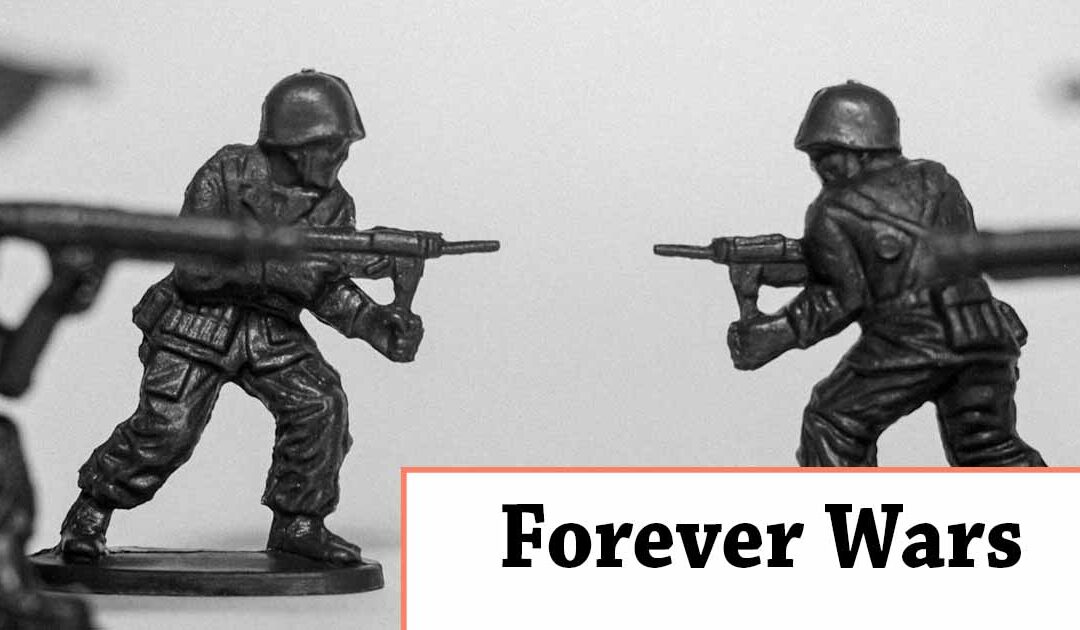
Permanent Wars, Hidden Money-Printing, and Shrinking Incomes
History has a strange rhythm. When nations run out of money or answers, they often find a new enemy.
Sometimes that enemy is a country. Other times it’s a disease, a drug, or even the climate.
Whatever form it takes, “war” becomes a convenient tool, a distraction that rallies the people, fuels spending, and hides deeper economic problems.
An Economy Under Pressure
Across many countries, the economy looks strong on paper but feels weak in real life. Prices for shelter, food, and energy stay high. Wages can’t keep up. Central banks, like the Reserve Bank of Australia or the U.S. Federal Reserve, are stuck:
• If they cut interest rates, inflation could rise again. (This will show up in assets like houses, used cars, physical goods, and commodities).
• If they raise them, more people lose jobs and homes. (Banks and governments fear deflation much more than inflation).
Governments, meanwhile, can’t stop spending. Public projects, social programs, and subsidies keep voters happy — but they all add to national debt. To pay for that debt, governments sell bonds to investors. Yet investors are getting nervous. They are demanding to be compensated for the increased risk. They see the huge mismanagement of money and demand higher interest rates. If rates rise too much, governments face a nightmare: interest payments eat up more of the budget. The usual fix, printing money or “quantitative easing” — risks starting another round of inflation. That’s why politicians quietly look for another way to boost spending and unite the public.
The Temptation of Conflict
Here’s where history’s old trick returns: war as distraction.
When people struggle at home, leaders often look abroad for problems they can blame.
A conflict, even a limited one, does several things at once:
1. It unites the population behind a common enemy.
2. It allows massive government spending without criticism.
3. It gives the media a simple story to tell — us versus them.
4. It lets leaders silence opposition in the name of “national security.”
War also acts as a kind of hidden economic stimulus. Governments can borrow and spend freely on defence, manufacturing, and infrastructure, saying it’s for safety. Central banks support those debts “to stabilize markets,” which quietly lowers interest rates — almost the same as printing new money. But now it’s called patriotism, not QE (technical term for money printing).
Forever Wars: Conflicts That Never End
Modern governments have discovered that a war doesn’t even need to end — or even be won — to serve its purpose.
Since the mid-20th century, a growing list of “wars” has been declared not on countries, but on ideas, behaviors, and social problems. The War on Terror, the War on Drugs, the War on Poverty, the War on Hunger, the War on Climate Change, and even the War on Tax Evasion have all become permanent programs.
Each one absorbs massive amounts of public money while keeping entire industries, bureaucracies, and political narratives alive. They give leaders rallying cries, justify endless budgets, and allow governments to appear busy “fighting for the people” — even when little changes for ordinary citizens.
The Common Pattern
These “forever wars” follow the same formula:
• They can’t be clearly won. There’s no final battle or peace treaty — only targets that can shift endlessly.
• They create new bureaucracies and jobs that depend on keeping the fight alive. Ending the war would mean firing thousands of people and cutting funding streams.
• They justify constant spending that no politician dares to challenge, for fear of looking weak or “soft” on the issue.
In economic terms, these wars act like continuous stimulus machines.
They pump money into defence contractors, law enforcement, intelligence networks, aid organizations, green technology firms, and tax compliance agencies. Some of that spending helps society, but much of it simply keeps the system moving, funnelling wealth upward and creating a cycle that is politically useful — but economically hollow.
The Cost of Fighting the Unwinnable
Let’s look at what these “wars” have cost the world:
• The War on Terror — Since 2001, the U.S. and its allies have spent an estimated $8 trillion on military operations, homeland security, and veteran care.
• The War on Drugs — Globally, over $1 trillion has been spent since the 1970s, with little impact on addiction or trafficking. Prisons filled up, but supply and demand never disappeared.
• The War on Poverty — The U.S. alone has spent more than $25 trillion since 1964. While it reduced extreme poverty at first, many programs became permanent bureaucracies with mixed results.
• The War on Hunger — The world has poured trillions into food aid and agricultural subsidies. Yet global hunger still affects over 700 million people, and much of the money circulates back to large agribusinesses rather than farmers in need. It also wipes out local farmers, who suffer when foreign food swamps markets and destroys their livelihoods.
• The War on Climate Change — Global spending on green initiatives, subsidies, and transition programs already exceeds $5 trillion and is growing fast. Some projects are vital, but others are riddled with inefficiency and corporate capture.
• The War on Tax Evasion — Trillions have been spent strengthening tax agencies, compliance systems, and international enforcement. Yet loopholes remain for the wealthy, while small businesses and individuals bear heavier scrutiny and costs.
When you add it all together, the total exceeds $40 trillion in public spending — more than half of global GDP in a single year. And still, none of these wars are close to being “won.” If you’re wondering who’s funding all this… you are! Your future taxes and those of your kids and grandkids will be used to pay back this phoney debt!
A Physical War Could Be Next
Now, in the mid-2020s, tensions are rising again:
• The U.S. and China compete over the Pacific and new technology.
• Europe faces pressure from immigration and energy politics.
• The Middle East remains volatile.
• Even smaller nations are building up arms in the name of “deterrence.”
A limited physical war — perhaps over a disputed island, a cyberattack, or a border incident — could easily ignite. Such a conflict would be tragic for the people caught in it, but it could also serve as the perfect political and financial cover for struggling governments. Defence budgets would surge. Jobs in weapons manufacturing and logistics would appear. Inflation from higher energy and food prices could quietly reduce the real value of old debts. Central banks could buy government bonds again “to support stability,” without calling it money-printing. To the public, it would look like national unity in a time of crisis. Economically, it would be hidden QE through the back door.
The 1984 Effect
During wars — real or symbolic — societies tend to close ranks. People who question the official story are branded unpatriotic or even dangerous.
George Orwell described this in 1984: endless war keeps citizens fearful and loyal, while truth itself becomes flexible.
“WAR IS PEACE.
FREEDOM IS SLAVERY.
IGNORANCE IS STRENGTH.”
We’ve already seen smaller versions of this.
During the pandemic, those who questioned lockdowns or vaccines were often silenced or mocked, even when their concerns were reasonable.
In a wartime setting, that pressure becomes far stronger. News outlets repeat the official line. Social media platforms remove “unhelpful” voices. Neighbors police each other’s opinions. White feathers may be sent over social media this time…
This is how economic distraction turns into social control. The war — whether against a virus, a nation, or an idea — becomes a test of loyalty.
A Dangerous Game
Using war to distract from economic failure might buy time, but it never solves the real problems:
• It raises prices through shortages and inflation.
• It deepens inequality, as defence contractors and investors profit while ordinary people pay higher taxes and costs.
• It damages freedom, since emergency powers are rarely given back once peace returns.
• And it often leaves nations more divided and more in debt than before.
History shows that every empire eventually fights one war too many — the one meant to hide its collapse.
Seeing Through the Illusion
Ordinary citizens aren’t powerless, but awareness is key.
Watch for warning signs: sudden rises in defence spending, constant talk of external threats, or governments using “emergencies” to silence debate. Media restrictions and Internet licences…
Ask questions about where the money is going and who benefits. Support journalism that investigates, not just spews forth government press releases and scripted narratives.
Written by John E Middleclass

Chitchat Newspaper. December 2025.