
Daleys Fruit Tree Nursery Interview
The Chitchat caught up with the crew from Daleys Fruit Tree Nursery last week to discuss their thriving online plant business and how the Bundaberg / Childers region can benefit from growing some rare, weird, and wonderful fruit.
Daleys has become a household name amongst permaculture enthusiasts and those tinkering with fruit trees in their backyard.
How did you build such a solid reputation and brand awareness?
Our reputation is built upon 45 years of growing and supplying an extensive range of good-quality trees. We started out selling at the local markets before expanding to become a wholesale supplier. Nowadays, we are an online retail store that is able to supply almost all of Australia with the trees they want to grow in their backyards. We aim to keep our customers happy and coming back for more. To do this, we maintain high standards of quality with our plants, and we listen to what our customers want, where possible, sourcing new varieties and selections to add to our existing range.
We have embraced technology as it has become available to us, and by promoting ourselves online, we have been able to build our brand name across the country, as well as raise awareness of edible plants.
Where did your passion for rare and unusual plants come from?
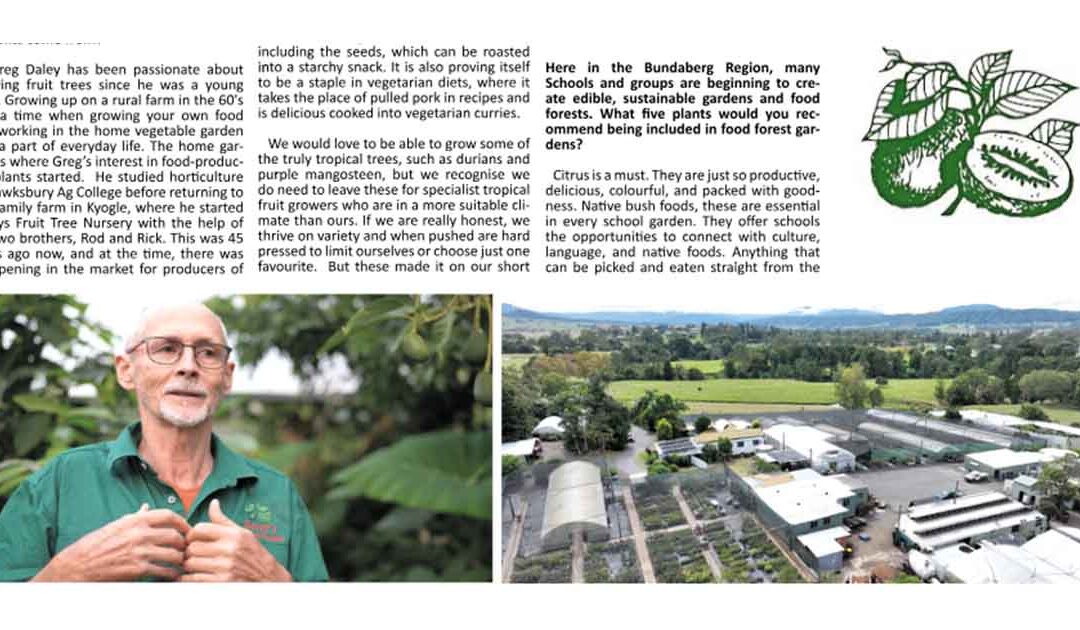
Greg Daley has been passionate about growing fruit trees since he was a young man. Growing up on a rural farm in the 60’s was a time when growing your own food and working in the home vegetable garden was a part of everyday life. The home garden is where Greg’s interest in food-producing plants started. He studied horticulture at Hawksbury Ag College before returning to the family farm in Kyogle, where he started Daleys Fruit Tree Nursery with the help of his two brothers, Rod and Rick. This was 45 years ago now, and at the time, there was an opening in the market for producers of edible plants.
NSW is an interesting choice for a tropical fruit tree business. Why did you choose to base your business in Kyogle?
Kyogle was the obvious place to start the business. Being in the Northern Rivers region of NSW, Greg recognized that we are blessed with our subtropical climate, ample rainwater, and rich soils, making it an ideal location to grow a wide range of both hardy tropical plants and low chill temperate varieties. Daleys Nursery was born on the outskirts of town, where it is surrounded by the green, rural landscape and views to the Border Ranges beyond. As the interest in edible plants continues to grow amongst the wider population and as more people are setting aside space in their backyards to grow some of their own produce, our range of edible plants continues to expand.
If there was one fruit tree you wished you could have in your possession to grow and distribute, what would it be?
Last week, we asked all our staff members if they could share with us what their favourite fruit is and why. This proved to be a very difficult question to answer, as we all love a wide variety of fruit and are spoilt for choice. There were, however, a few that came up repetitively, and one was the Jackfruit. It is such a beautiful tree, and the fruits are large and versatile. One fruit can feed the family, they can be eaten fresh, frozen, or dried, and all parts of the fruit are edible, including the seeds, which can be roasted into a starchy snack. It is also proving itself to be a staple in vegetarian diets, where it takes the place of pulled pork in recipes and is delicious cooked into vegetarian curries.
We would love to be able to grow some of the truly tropical trees, such as durians and purple mangosteen, but we recognise we do need to leave these for specialist tropical fruit growers who are in a more suitable climate than ours. If we are really honest, we thrive on variety and when pushed are hard pressed to limit ourselves or choose just one favourite. But these made it on our short list: Canistel, Dragonfruit, Grumichama, Longan, Rollinia and White Sapote
What are some of the most useful trees you stock? Are they simply delicious or do they have a multitude of health and ecological benefits?
The jackfruit, as we have mentioned, is a fabulous fruit but also can be used as a windbreak tree to protect other more sensitive trees. Another is the Drumstick Tree, Moringa oleifera, which is often called the miracle tree, or tree of life, due to the fact that it is possibly the most useful tree in the world. It is fast-growing and drought-resistant. It is primarily grown for its edible foliage, which can be used as a highly nutritious vegetable. Claims are made that the tiny leaves contain 7 times the Vit C of oranges, 4 times the Vit A of Carrots, 4 times the Calcium of milk, 3 times the Potassium of Bananas, and 2 times the protein of yogurt. The young seed pods are also harvested as a vegetable and are said to taste like a cross between asparagus and peanuts. The fresh roots can be harvested and used as a substitute for horseradish, and the ripe seeds can be agitated in dirty water to settle the sediment.
The native Gossamer Wattle, Acacia floribunda, is another outstanding tree in terms of its usefulness. It is a nitrogen-fixing tree that produces beautiful flowers that are attractive to birds, bees, and insects. It is hardy and fast growing, providing shade for other more sensitive trees, and it can be pruned back as a source for mulch.
Here in the Bundaberg Region, many Schools and groups are beginning to create edible, sustainable gardens and food forests. What five plants would you recommend being included in food forest gardens?
Citrus is a must. They are just so productive, delicious, colourful, and packed with goodness. Native bush foods, these are essential in every school garden. They offer schools the opportunities to connect with culture, language, and native foods. Anything that can be picked and eaten straight from the tree, such as Panama berries, these little red fruits taste like vanilla ice cream, what is not to love? Cape gooseberries, blueberries, mulberries, in particular the red shahtoot, as it is a dwarf tree and does not stain like the black mulberry does, and apples, they are delicious and great trees for climbing.
What advice would you have for young gardeners in the Bundaberg area wanting to create edible landscapes?
Grow, share, learn, and connect. Growing your own food starts at home, in pots, on patios, and in the backyard patch. If you have the chance to grow your own food, you connect with the earth, the plants, the goodness of food, as well as friends and family with whom you will share your harvest. It can become a lifelong passion that is both a learning experience and will give you the chance to experience all the different flavours of this fantastic planet.
Would you like to order from Daleys’ online retail?
You can use the code CHITCHAT15 for 15% off your order, for a limited time.
We would love to be a part of your fruit tree-growing journey!
Chitchat Newspaper. February 2026.