
Beliefs And Borders
Ownership is a comforting idea. You buy a block, sign the paperwork, and assume the ground beneath you is yours. In practice, that belief is only as good as the laws that protect it. Zoning laws dictate how and what you can build. Easements let other people pass through your land. Councils milk you like dairy cattle, or turn you into beef cattle if you don’t cough up money every quarter. Mineral rights can separate you from the soil beneath your feet — a legal quirk that quite literally undermines your sense of ownership. Even personal relationships complicate things, with de facto laws of entitlement, wills, and probate capable of reshaping property claims.
What these examples have in common is that ownership is not just a personal belief; it is a legal construct. Property exists because laws define it, protect it, and enforce it.
Across the world, belief and recognition are locked in a constant tug-of-war. Right now, U.S. President Donald Trump publicly floated the idea of the United States purchasing Greenland, a vast, ice-covered territory belonging to the Kingdom of Denmark. Denmark declined the offer, apparently unconvinced that sovereignty is a matter of price per square kilometre, or that “make an offer” is a recognised principle of international law.
On that note…
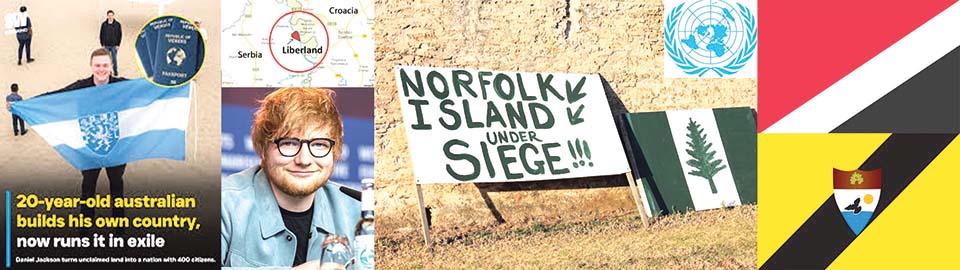
Liberland, a micronation formed on a disputed patch of land between Croatia and Serbia, insists it is a sovereign libertarian state. Sealand, formed off the coast of Britain, in International Waters, claims de facto sovereign status and has even defended its territory with arms. Both have constitutions, flags, and devoted supporters (Ed Sheeran is a citizen of Sealand), yet neither is recognised.
Meanwhile, Taiwan operates as a nation in almost every practical sense, and Palestine is recognised by many countries, but both remain constrained by the limits of international acceptance by the UN. Belief, it turns out, is only half the equation.
Australia even has its own micronational President. In 2019, Daniel Jackson declared the Free Republic of Verdis on a disputed stretch of land along the Danube, leaning on the doctrine of terra nullius. Australians are familiar with the term: it was the legal framework used to justify Britain’s claim over Australia, dismissing Indigenous Australians. Jackson’s attempt to apply the same logic abroad proved less effective. Croatian authorities banned him from the territory, and Verdis now operates largely online, selling E-Citizenship— a nation in exile with no UN recognition.
That recognition, lightly joked about but deadly serious, largely comes down to the United Nations. Without UN recognition, borders remain theoretical and sovereignty symbolic. With it, even the smallest states gain legitimacy. It is an imperfect system, but for now it is the one that decides who exists on the world stage.
Closer to home, borders are being questioned in quieter but no less significant ways. On Norfolk Island, many residents argue that Australia’s government is still in the business of colonisation. Australia’s forced abolition of local self-government in 2016 amounted to a modern act of colonisation. The federal government frames it as administrative reform; locals describe it as the loss of autonomy over their own affairs.
One can only wonder what the future of Indigenous Australian sovereignty may look like. We may live to see an island nation off the Fraser coast, or require a passport to head down to NSW if the federation fractures.
As property values rise and political conversations become more complex, it is reasonable to expect renewed attention on the foundations of ownership itself. Questions of land rights, recognition, and governance are not theoretical—they shape markets, investment confidence, and long-term security.
For property owners and aspiring buyers alike, this matters. Real estate does not exist in isolation from the legal systems that support it. Titles, contracts, zoning, and enforcement rely on stable institutions and the rule of law. When those structures are strong, ownership is secure. When they weaken, uncertainty follows.
Ultimately, ownership is not just about land—it is about trust. Trust in laws, in institutions, and in the systems that recognise and defend what we believe is ours. Borders may change and beliefs may shift, but prosperity endures only where the rule of law remains firm.
Chitchat Newspaper. February 2026.