
Food has a funny way of both connecting and repelling us. Take coriander, for example: to some it’s fresh and citrusy, to others it tastes unmistakably like soap or a wet boot.
Around a shared table, especially at Christmas or New Years, these differences are what make the holidays special. We laugh about them, negotiate around them, and sometimes quietly scrape items to the side of the plate (or to the dog).
Sharing food is never just about eating — it’s about experiencing taste, habit, and human behaviour.
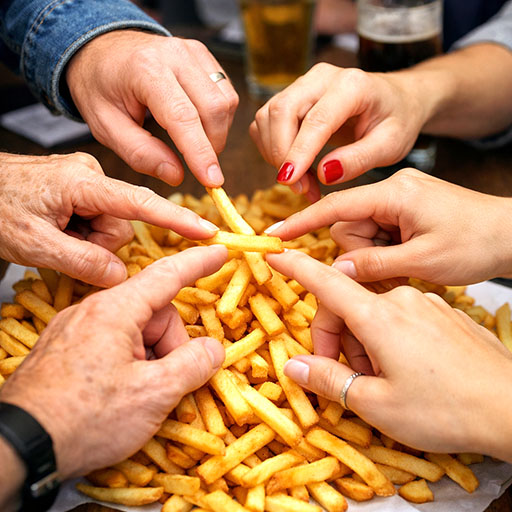
But, beyond differing palates, there’s a stranger phenomenon that emerges when food is shared. Even when there’s abundance — hundreds of grapes on a fruit platter or a mountain of hot chips generously shaken with chicken salt — people somehow reach for the exact same piece of food.
Again and again. I’ve watched this play out countless times with friends and family, but nowhere more reliably than with my wife and children. Without fail, just as my hand moves toward a particular chip, another hand swoops like a seagull at precisely the same moment, aiming for the very same chip.
At first, it feels improbable. With so many options, how could we keep choosing the same hot chip? Is this just a coincidence, or could there be something else at play?
Part of the answer may lie in observation bias — the same phenomenon that makes us suddenly notice yellow cars everywhere once we’re asked to look for them, or spot our obscure car model on every second street after buying one. Once we notice something, our brain gives it more weight. Each shared reach becomes memorable, while the hundreds of times we don’t collide fade into obscurity. But there may be more to it. Humans are subtle imitators. We unconsciously track movement, gravitate toward visually “better” options, and mirror the behaviour of those closest to us. The chip that’s slightly longer, crispier, or better seasoned draws multiple eyes at once.
In families, shared rhythms develop similar timing, similar instincts, similar reaches — especially when we’re relaxed and distracted by conversation.
Perhaps that’s the real charm of sharing a meal. These small collisions over food aren’t always inconveniences; they’re tiny moments of connection. Shared hunger, shared habits, shared laughter.
Over the holidays, when plates are passed and bowls are replenished, reaching for the same chip might just be another way of connecting. After all, tis the season-ing.
Written by Dusty Salt-ington