
What We Wish We Knew Before We Went
It is not every month Chitchat gets to report from another country, so when we found ourselves in Vanuatu, naturally we did the beaches, snorkelling and kayaking, but we were equally curious about how the locals live, what makes the place tick and, of course, what they put in their newspapers.
So rather than give you another glossy travel story telling you Vanuatu has beautiful beaches (spoiler: it does), here are some of the things we discovered that might actually be useful if you’re thinking of going.
First Things First: Don’t Pack a Power Adapter
Australians can leave the international adapter at home. Vanuatu uses the same style of power points as Australia.
Money is the Vanuatu vatu (VUV) and it pays to understand the exchange rate before you arrive. ANZ and BRED are two of the banks you’ll commonly see around Port Vila.
If you don’t fancy joining the queue at the airport currency exchange, we found an ATM just outside the airport near the taxis. Our withdrawal was capped at 40,000 vatu per person, roughly around $400 Australian at the time.
And here’s something Australians might find refreshing: you don’t need to tip. Tipping isn’t part of the traditional culture and can even be considered inappropriate in some situations. Good service doesn’t automatically mean reaching for another 20 per cent.
Don’t Be Afraid to Leave the Resort
Resorts are wonderfully convenient, but walk outside and prices can change considerably. We found everyday supplies outside the resort for around a third of what we would have paid inside.
Food at the resort was roughly comparable to Australian prices, although buffet meals can make things surprisingly economical. A decent breakfast followed by dinner meant we could comfortably get away with two main meals a day.
Families should also investigate their resort’s children’s deals. Where we stayed, kids ate free at breakfast, lunch and dinner, and if they were at Kids Club, staff would even take them for their meal and bring them back afterwards.
That’s a holiday for the parents too.
Catch the B Bus
One of our favourite discoveries was Vanuatu’s wonderfully informal public transport. Look for vans with a B on the number plate. These operate like buses, except there isn’t necessarily a traditional bus route. You tell the driver where you want to go and, for around $2–$3 AUD, they’ll get you there.
Just don’t expect a private chauffeur. Other passengers will jump in and out along the way, so be prepared to share your ride with locals.
It is cheap, practical and a much more interesting way to see everyday Vanuatu than staring through the window of a tour coach.
Yu Save Ridim Bislama?
The children quickly decided they were linguistic geniuses when they discovered they could read Bislama, one of Vanuatu’s official languages.
Bislama is an English-based creole and much of it is written phonetically, so once you start sounding the words out, things begin falling into place.
Their first lesson came courtesy of a bottle of Nambawan Water and its motto: Gud Wota, Gud Laef = Number one water. Good water. Good life.
From then on, the kids were reading signs from the bus window and having a wonderful time deciphering them.
Music, Bush Bass and a Vanuatu Welcome
We were greeted by a local string band, which was one of those moments that immediately tells you you’ve arrived somewhere different.
The quartet sang in Bislama, often in falsetto, accompanied by guitars and the distinctive bush bass, essentially a timber box, pole and string transformed into an instrument.
Simple? Yes. Forgettable? Absolutely not.
String-band music has become part of Vanuatu’s cultural soundtrack, and hearing it live was almost as good of an introduction to the country as being rushed through airport arrivals because we had children in tow.
Get in the Water
With 83 islands, it would be criminal to visit Vanuatu and stay dry.
We made it across to Hideaway Island, where we posted a letter from the famous underwater post office and snorkelled amongst clownfish. It is difficult to beat sending someone a postcard while wearing a snorkel.
There are plenty of other options if you want to venture further. Roawia offers turtle encounters and snorkelling near Mangaliliu village, while the Rentapao River area offers waterfalls and beautiful freshwater swimming.
Then there are Vanuatu favourites such as the Blue Cave, Blue Lagoon, island trips and ziplining. If supporting local operators matters to you, ask who owns and operates a tour before booking. Tourism dollars can have a very different impact depending on where they ultimately end up.
Learn to Sail, What Could Possibly Go Wrong?
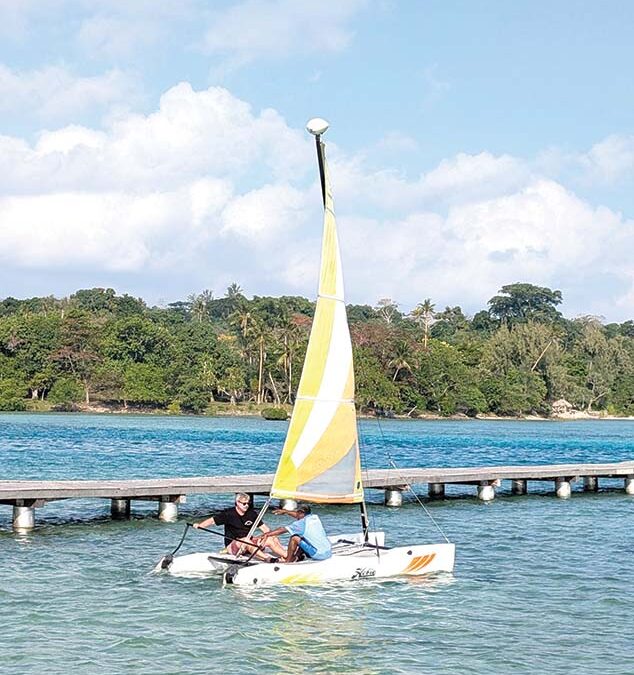
You don’t necessarily need to leave the resort to find something to do. We had a brief sailing lesson from an elderly gentleman named Mr Ronald before being let loose on Hobie Catamarans in the lagoon.
This proved highly entertaining when a young couple came racing back towards shore and couldn’t work out how to drop their sails. In the panic, they lifted one of the rudders, which naturally improved the situation enormously by sending them hurtling towards the rocks.
Depending on where you stay, you’ll find activities for adults ranging from sailing and coconut husking to bonfires and organised tours. It is worth checking the daily activity board rather than assuming the resort is simply somewhere to sleep between excursions.
Eat Something Local
One unexpected discovery was wild raspberries.
Rubus rosifolius grows in Vanuatu and is known locally in Bislama as frombwas, derived from the French framboise. Finding raspberries growing on a tropical Pacific island certainly wasn’t on our Vanuatu bingo card, but they were delicious.
And then, of course, there is kava. We’ll leave it up to you whether that particular Vanuatu experience makes your holiday itinerary.
Read the Local Paper
Naturally, I couldn’t travel overseas without investigating the local newspaper situation.
Vanuatu has a population of only around 330,000 yet supports its own news media, including the Daily Post, which has a paid digital offering.
For tourists, keep an eye out for the free What To Do in Vanuatu publication, produced twice a year and packed with visitor information.
I picked up the local papers expecting to find completely different concerns from home. Instead there was plenty about government, education and politicians.
Apparently some things are universal.
Look Beyond the Resort Gates
One of the more interesting people we met was Roy, a local tour guide who picked us up on our way into Port Vila. A conversation with him quickly became a lesson in Vanuatu beyond the resorts.
Land ownership, for example, works very differently from Australia. Under Vanuatu’s Constitution, land belongs to indigenous customary owners. Foreigners generally access land through leases rather than owning the underlying land outright.
Roy also talked about the increasing amount of overseas investment in tourism and infrastructure. Australia remains a major aid partner, while Chinese investment and financing is highly visible.
For travellers, it is an interesting reminder that the resort, tour, restaurant or attraction you’re spending money with might be locally owned, foreign owned or somewhere in between.
If you want more of your holiday dollar to stay within the community, ask questions and seek out locally owned operators where you can.
Kastom Is Still Very Much Alive
Vanuatu isn’t simply beaches and resorts. Traditional kastom remains an important part of life alongside Christianity, animal sacrifices, modern government and tourism.
Thankfully there is no longer cannibalism.
The word tabu is commonly seen and heard throughout the islands, while traditional ceremonies, community rules and rites of passage remain part of life in many places.
That mixture of old and new is part of what makes Vanuatu so interesting. You can spend the morning snorkelling, catch a $3 bus with locals in the afternoon, hear Bislama and traditional music, then return to a modern resort for dinner.
Our Chitchat Tips Before You Go
Power: Same plugs as Australia — leave the adapter at home.
Money: Learn the vatu exchange rate before arriving. There are ATMs around Port Vila, including near the airport.
Transport: Look for the vans with a B plate. They’re cheap, shared with locals and an experience in themselves.
Food: Resort prices can be similar to Australia, so check whether your accommodation includes buffets or kids-eat-free deals. Walk outside the resort for cheaper everyday supplies.
Language: English is widely useful, but have a crack at Bislama. It’s great fun to decipher and even the kids can quickly pick up words.
Activities: Don’t just book the obvious tours. Ask about local operators, villages, waterfalls, snorkelling, sailing, cultural activities and locally owned attractions.
Newspapers: Grab a copy of What To Do in Vanuatu when you see one, and if you’re curious about what’s actually happening in the country rather than just where happy hour is, check out the Daily Post.
Vanuatu certainly delivers the tropical holiday you see in the brochures, warm weather, turquoise water, islands, waterfalls and palm trees, but there is far more going on than a week beside the pool will ever show you.
Published September 2026 Chitchat Newspaper