
In a Melbourne laboratory, something deeply unsettling is taking place .
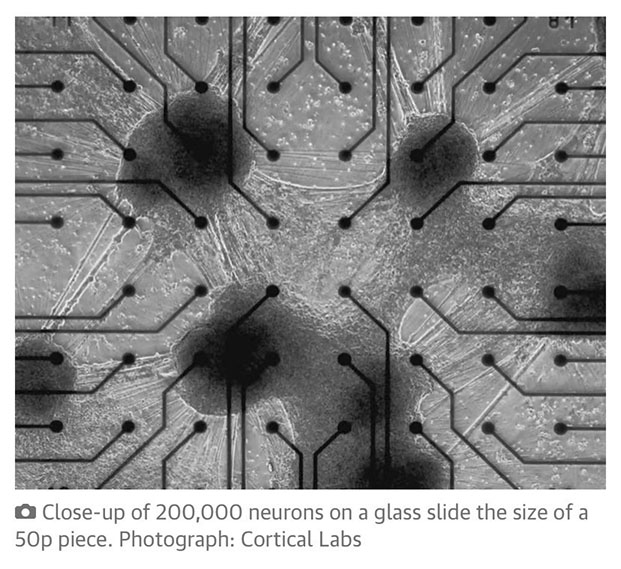
Researchers at Cortical Labs have grown living human neurons from blood cells, placed them on a silicon chip, and wired them into a computer system. You may recall my previous Dose of Gross where the same lab had success training human brain cells to play the video game pong.
Roughly 200,000 brain cells are now levelling up. They are interacting with software and learning to play the 1993 video game Doom. This is not artificial intelligence simulating thought. It is human biological tissue functioning as part of a machine — a “biological computer” powered by living cells.
Proponents emphasise its remarkable efficiency. Human neural tissue consumes only 20 watts, a tiny fraction of the energy required by conventional computers, whose data centres devour electricity on an industrial scale.
There’s just one problem… it’s slow to teach. They need a human trainer with a brain implant hooked up to a training device.
Next step … volunteers.
Direct implants into human brains would accelerate learning by training neural pathways — a prospect being pursued by companies such as Neuralink, led by Elon Musk. Vast capital flows into tech and biotechnology are off the charts. The Magnificent 7 tech stocks Alphabet (GOOGL), Amazon (AMZN), Apple (AAPL), Meta Platforms (META), Microsoft (MSFT), Nvidia (NVDA), and Tesla (TSLA) has more capital than entire energy markets. They also have near unlimited financial backing.
For a class of billionaires accustomed to solving every problem with money and money printing, death itself has become the ultimate challenge to overcome. As most are advancing in years, the race is truly on.
The trajectory is clear: from neurons on glass, to chips in brains, to artificial heaven and the pursuit of a man made triumph over death.
In 2019, Microsoft filed an international patent application (WO/2020/060606) describing technology that could be implanted to monitor human activity and reward it with cryptocurrency — a concept in which the body becomes a node in a computational network.
Individually, each development can be framed as innovation. Together, they harmonise and point toward a future where human experience itself is harvested, altered, monetised and controlled.
The battle lines have been drawn. Are we made in the image of God or will man remake himself in his own image?
Earlier generations feared domination by machines. The more immediate possibility is something subtler: not that machines become human, but that humans gradually become machine. Whether this represents progress or a loss is up to you, the reader. But don’t bury your head in the sand.
It is unfolding now, quietly, on a laboratory bench in Melbourne.
By Frank Ian Stine Jr.
Chitchat Newspaper. April 2026.