
The weather is warming, the days are getting longer and, after months of looking at the ocean and deciding it is far too cold, Bundaberg locals are starting to venture back into the water. Whether your spot is Archies, Kellys, Elliott Heads, Moore Park Beach, Woodgate or somewhere else along our coastline, spring is a pretty good time to remember one important thing, we aren’t the only ones swimming out there. We share our coastline with turtles, rays, dolphins, dugongs, whales, sharks and countless other marine creatures. Most of the time we go about our business and they go about theirs, but recent events have provided a timely reminder of just how much can be happening beneath the surface.
In March 2026, Kellys Beach at Bargara was intermittently closed after significant shark activity was detected close to shore. The Courier Mail reported hundreds of sharks feeding near the beach, including large schools of bull sharks. A tiger shark detected by drone surveillance prompted another closure.
Surf Life Saving Queensland representative Russell Blanchard explained at the time that offshore breezes had brought baitfish closer to shore, attracting sharks to feed. He also made an important point, increased sightings do not necessarily mean there are suddenly more sharks in our waters. Better surveillance, including drones, simply means there are now more eyes looking for them. In June, an adult humpback whale washed ashore at Mon Repos Beach. Its carcass naturally attracted an extraordinary number of marine scavengers, including sharks, with authorities warning people to keep clear of the area and out of the water.
Kellys has had other confirmed encounters over the years. In March 2024, a 13 year old girl was bitten by a shark while swimming at Nielson Beach. In 2020, the beach was cleared after a hammerhead was spotted close to shore, while just along the coastline at Archies Beach a dead dugong washed ashore that same year following what was reported to be an apparent encounter with a shark. And as we have seen locally, conditions can change quickly. A beach that was perfectly uneventful yesterday can have baitfish schooling today, marine animals feeding tomorrow or a shark passing through an hour before you arrive.
MORE EYES ON THE WATER
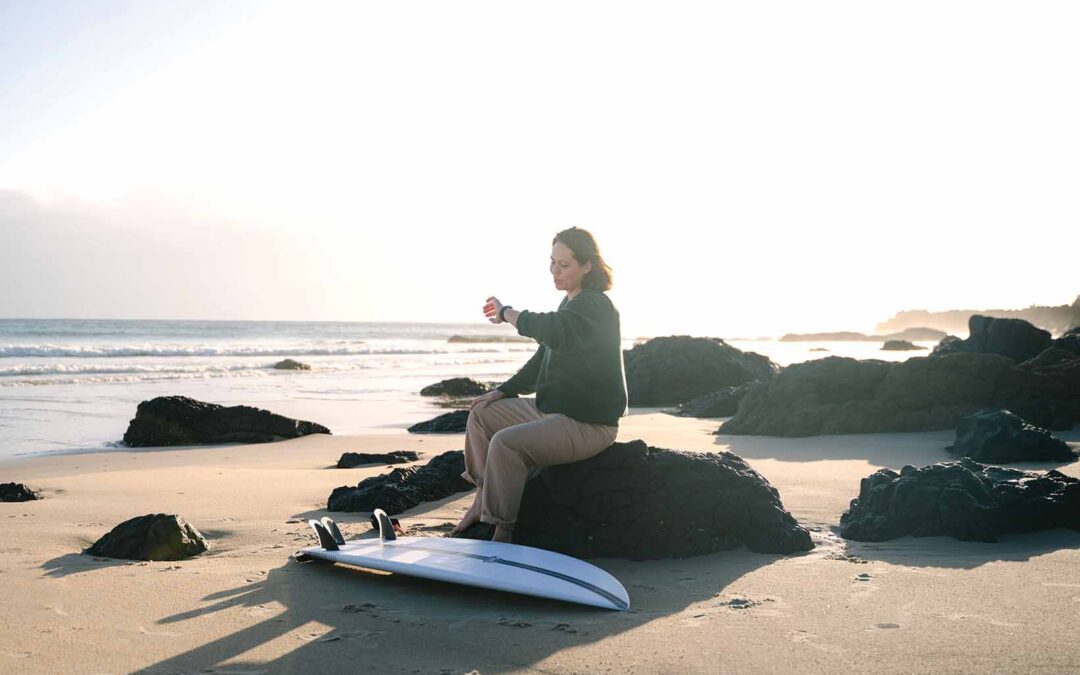
Technology is increasingly giving beachgoers another way to know what may be happening before they jump in. One example is Dorsal, an Australian community-based shark reporting network established in 2015. Dorsal Watch is co-founded by former professional surfer Sarah Beardmore, who competed internationally for Australia. Having spent plenty of time in the ocean herself, Beardmore is now helping to get more eyes on the water. Rather than being a shark-detection system itself, Dorsal brings together information from official channels and reports submitted by members of the public, distributing sightings through its website and app. Public reports are vetted by the Dorsal team, with information including the submitter’s details and GPS location used as part of the verification process. Dorsal itself cautions that it cannot guarantee the accuracy of every report and that people must ultimately assess the conditions and risks for themselves. An app isn’t a substitute for lifesavers, beach closures, official warnings or simply looking at what is happening in front of you. It is another source of information. Dorsal is also developing technology that could make those reports more useful while people are actually at the beach, including the ability for recreational drone operators to submit sightings and smartwatch notifications designed to alert swimmers and surfers when a nearby sighting has been confirmed.
Closer to home, Kellys Beach is also part of Queensland’s SharkSmart drone surveillance program, giving lifesavers another set of eyes above the water. Sometimes those eyes may simply belong to another beachgoer. If you see something concerning, tell the lifesavers. If the beach is closed, stay out. If baitfish are schooling, birds are diving or obvious feeding activity is occurring, perhaps that’s the day for a walk along the sand instead.
SHARK BITE: WOULD YOU KNOW WHAT TO DO?
Shark bites are rare, but knowing what to do in the unlikely event of one could save a life. The Australian and New Zealand Committee on Resuscitation specifically lists shark attacks among injuries that should be treated as potentially severe, life-threatening bleeding. The priority is simple: get the person safely out of the water, call Triple Zero (000) and stop the bleeding. Apply firm, direct pressure on or around the wound. In cases of life-threatening bleeding, ANZCOR advises that controlling the bleeding takes priority over airway and breathing interventions. For severe bleeding from an arm or leg that cannot be controlled with direct pressure, an arterial tourniquet can be applied above the bleeding point if one is available and the person providing first aid is trained to use it. Commercial tourniquets are preferred, but in a life-threatening emergency ANZCOR says an improvised tourniquet may be better than none. A triangular bandage, clothing, elastic bandage or even a surfboard leg rope may be used with an appropriate windlass. Once applied, the time should be recorded and the tourniquet should remain in place until specialist medical care is available. Where a tourniquet cannot be used, continue firm pressure. A haemostatic dressing may also be used for life-threatening bleeding where available and where the first aider is trained in its use. If the person becomes unresponsive and is not breathing normally, commence CPR and follow the instructions from Triple Zero. Keep them lying down, warm and as still as possible while waiting for paramedics.
Remember: with a catastrophic shark bite, call 000 and STOP THE BLEEDING.
First aid courses throughout our region can provide practical training in severe bleeding control, including the use of tourniquets and haemostatic dressings. It isn’t a bad skill to have, whether the emergency involves a shark, a workplace accident, a car crash or something else entirely.
Be Aware Not Afraid
None of this is a reason to spend summer frightened of the ocean. Quite the opposite. We live in Australia. We share the place with snakes, spiders, jellyfish, crocodiles and, yes, sharks. It’s part of living here. We don’t stop bushwalking because snakes exist, and we don’t need to stop swimming because sharks do either. Sharks have always been in our waters. What has changed is our ability to see them, track sightings and share information quickly.
So, be aware, not afraid. As the weather warms, grab the swimmers, slap on the zinc and enjoy our beautiful coastline. After all, if we waited for Australia to be completely free of things that could kill us, we’d never leave the house.
Published Chitchat Newspaper October 2026