
Many old Queenslanders, such as ours, are over 100 years old. With effort and the right products, they can be saved.
Two problems present challenges: woodrot and rust. There are good remedies, not too expensive, but they are not well known. I begin with woodrot, in a house that was basically sound but had woodrot in some locations. The primary location in my house was the windowsill under the kitchen windows. It took me several tries to get it right.
1. Remove loose wood, but leave firm wood.
2. Brush or spray Glycol (antifreeze) onto the rot area. Glycol is a powerful fungicide; it kills woodrot and mould. Dave Carnell, a chemical engineer who worked for Dupont, discovered the fungicidal properties of Glycol when trying to fix rot in his boat. He wrote a paper called Chemotherapy for Rot
https://davidbeede.com/simpleboats/chemorot.html.
There are several kinds of Glycol – green, red and clear. Any will do the job, but I prefer the clear kind, which is Propylene Glycol. 5 litres costs about $70, in hardware stores and eBay. One kind of Glycol, Polyethylene Glycol (PEG), is used by archaeologists to restore Viking ships and American Indian canoes that sank thousands of years ago.
3. Next day, brush or spray Earls Wood Hardener onto the treatment area. A litre costs about $60; a 250ml spray bottle costs about $27. Wood Hardener does harden the damaged wood, and for the long term, but it does not contain a fungicide. That is the reason for applying Glycol first. I have not found any adverse effect from applying Glycol under it.
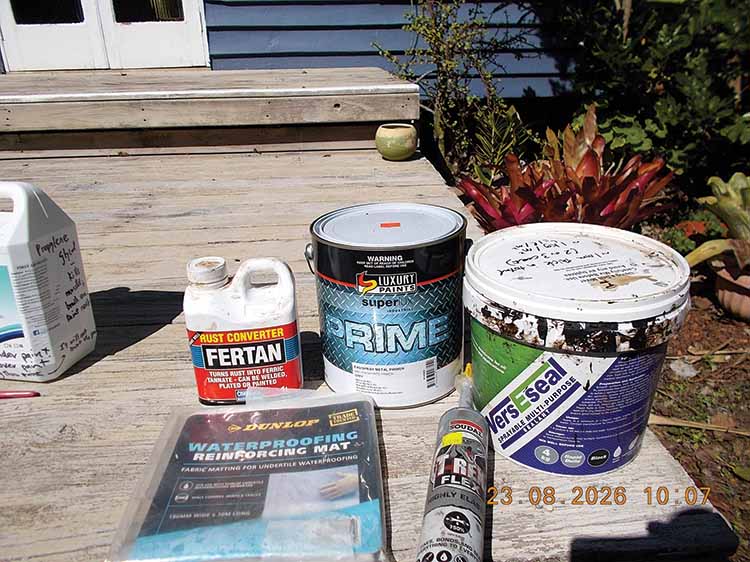
4. Next day, apply a filler. The usual advice is to use a Builders Bog. I tried Builders Bog, No More Gaps (Exterior), Powder Putty, Multfil, and Multflex, but found that all of them dried out and shrunk over time, becoming loose. I discovered cracked paint on top, and, removing it, the filler was loose. I had to remove it all. The only sealant that worked was Soudal Fixall (now sold as Soudal T-Rex Flex). This is a polymer sealant. Other polymer sealants also work, eg Selleys Storm, and the Sika ones. Polymer sealants are a new type, that have only been available for a few years. They combine the best qualities of silicone and polyurethane, and are better than both. They are ideal for filling gaps or cracks in weatherboard buildings. They are far better than no-more-gaps sealants. But polymer sealants cannot be sanded (unlike Builders Bog). You finish them with your finger, or with a trowel or paintscraper dipped in mineral turps. For wider gaps, apply sealant, then fabric, then more sealant. Soudal Fixall (T-Rex) is an adhesive, a filler, a sealant, is UV-stable, contains anti-mould, and can be painted. A local builder put me onto it; he said that they use it for everything. Roof, Gutter, timber. Advantages over silicone include: (i) silicone is not an adhesive (if you use it to fill holes on a roof, it lifts); (ii) polymer sealants adhere to damp surfaces; a few drops of rain are no worry (iii) polymer sealants can be painted. Advantages over polyurethane include: polymer sealants are UV-stable.
5. Next, paint with a water-based paint.
Now for Rust remedies, e.g. for gutters.
1. Rub any loose rust off with 60-grade emery paper; do not use a coarser grade, or it might scratch the surface.
2. Vacuum the dust off with a cordless vacuum-cleaner. The outlet pipe can hang over the gutter.
3. Brush or spray Fertan or similar tannin-based Rust Converter onto the gutter or roofing iron. Rusty metal turns blue-black, but unrusted metal retains its original colour. Water cleanup. It uses tannic acid, produced from tree bark, much as was used to tan animal hides in ancient Rome. It converts rust to Ferric Tannate, a blue-black metal that is stable and will not corrode further, but it needs to be painted if exposed to weather. Fertan is the standard; it an old product, made in Germany, but very expensive; one litre at hardware stores or eBay costs $80. Alternatives are much cheaper, but they must contain tannic acid (may also contain some phosphoric acid). Test to see if they turn rusty metal black.
4. Next morning, wipe off the black residue with damp cloths, rinsing them frequently. When the metal is dry, give it a coat of a Zinc Phosphate primer. I use the Luxury Paints grey one; this puts Zinc galvanising back into the metal. Turps cleanup.
5. Next day, give it a coat of Verseseal Rapid Build Liquid Rubber Waterproof Sealant. Gutters etc need two coats. A 4 kg bucket costs about $120; it did 2 coats to all the gutters on my house. Thinners cleanup, or use an old brush and discard it. Wear disposable gloves, because it sticks to everything. It is registered as potable, and is used by Sydney Water and Qld water authorities to waterproof the insides of huge concrete reservoirs
https://verseseal.com.au/tank-waterproofing/.
Use fibreglass fabric at holes or joins: apply Verseseal first, then fabric, then more Verseseal. Verseseal is UV-stable, meaning that no further coat is needed, but it’s black. For caravan roofs, a coloured top coat is available. Alternatives include Duram 195 Waterproofing Membrane and Duram Azcothane REO. These are polyurethane sealants with UV stabilisation. Older products used bitumen, but these new membrane sealants are tar and bitumen free.
Fixing my gutters was a lot of work, but what a relief to have it done!
Written by Peter Gerard Myers
Published Chitchat Newspaper October 2026