
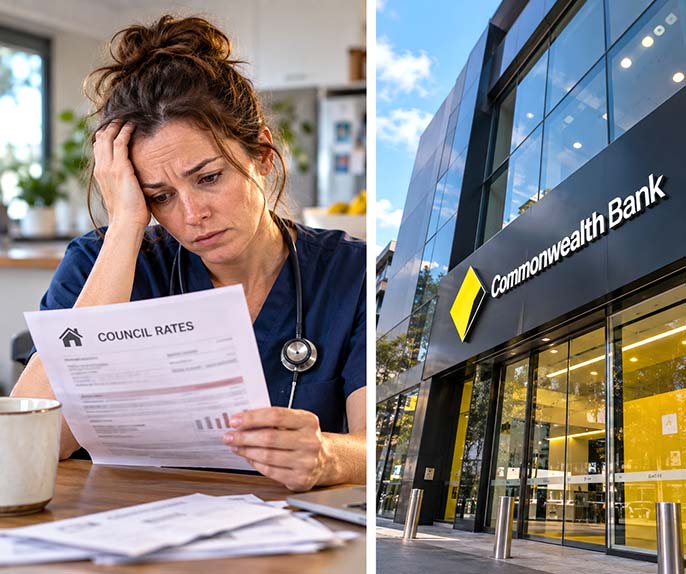
Having a job was once considered one of the strongest protections against poverty. But as the cost of housing, groceries, insurance, utilities and other essentials rises, a troubling class is becoming increasingly visible in Australia: the working poor.
These are not people without employment. They are people turning up to work, earning a wage and still struggling to afford the basics.
That issue has been thrust into the spotlight at Commonwealth Bank, where more than 3,000 employees have signed a Finance Sector Union petition calling for a better pay offer.
More than 1,700 workers also shared their experiences with the union, with some describing taking second jobs, living pay-to-pay, cutting holidays and children’s activities, struggling with medical expenses and even fearing homelessness.
“We should not have working poor in Australia but that is exactly what we are seeing at CBA,” FSU National Secretary Julia Angrisano said.
The union says around 71 per cent of CBA’s Australian workforce would receive an increase below inflation in the first year under the bank’s current offer, while employees are seeking annual increases of 5 per cent or CPI, whichever is higher.
The dispute comes after CBA announced an $11 billion after-tax profit, while CEO Matt Comyn’s remuneration increased 30 per cent to $9.1 million.
Perhaps the bigger story extends beyond one bank or one workplace.
For generations, society has broadly described people as belonging to different economic or social classes. The boundaries are far from exact, and income is only one factor, but the traditional picture looks something like this:
Upper Class: A relatively small group with substantial wealth and assets. Income may come from investments, businesses or inherited wealth rather than being solely dependent on a wage.
Middle Class: Generally includes professionals, managers and other skilled workers. Households are more likely to have accumulated assets and savings and have greater financial capacity to absorb unexpected expenses.
Working Class: People who primarily depend on wages from their employment, traditionally associated with trades, manual labour, manufacturing and service industries. They may have fewer accumulated assets or savings and rely heavily on continued employment to meet their living costs.
Working Poor: People who are employed, sometimes full-time or working multiple jobs, but whose income is still insufficient to comfortably meet essential living costs. They may live pay-to-pay, have little or no emergency savings and find that one large bill, rent increase or unexpected expense can push the household into financial hardship.
Lower Class / Poor: Also known as the Under Class, People living with very low incomes or which may include those who are on government financial aid, unemployed, or unable to work. Housing, food, utilities and other basic necessities can consume most or all available income.
The important distinction is that the working poor do not fit neatly into the old assumption that having a job protects someone from poverty.
For generations, employment has carried an expectation that working should provide a reasonable level of financial security. The emergence of the working poor challenges that assumption.
When people can work full-time and still worry that one unexpected bill could tip the household over the edge, the cost-of-living conversation is no longer simply about those without jobs. It’s about those who have them, and why they can’t make ends meet.
Published Chitchat Newspaper October 2026