
History remembers its great empires, bloody revolutions, and conquering armies. Yet tucked away in a forgotten little province of Italy is the story of one of the world’s most peaceful micronations. Almost nobody has heard of it. It flourished for close to 400 years without needing to conquer anyone. It raised no army; it wanted nothing to do with government at all. The strangest part is why nobody talks about it today.
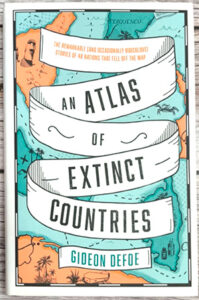
I recently read An Atlas of Extinct Countries by Gideon Defoe. The book examines 48 countries and territories that have completely disappeared from the map. It includes tales of bold explorers, libertarian idealists, dreamers, successful anarchists and tyrannical megalomaniacs. Light reading for a Sunday afternoon.
I’m rather glad most of the countries covered in the book have now vanished. However, a few gems disappeared well before their time, and these in particular left me wondering why they receive only a fraction of the attention we give history’s bloodthirsty civilisations.
NEW CALEDONIA
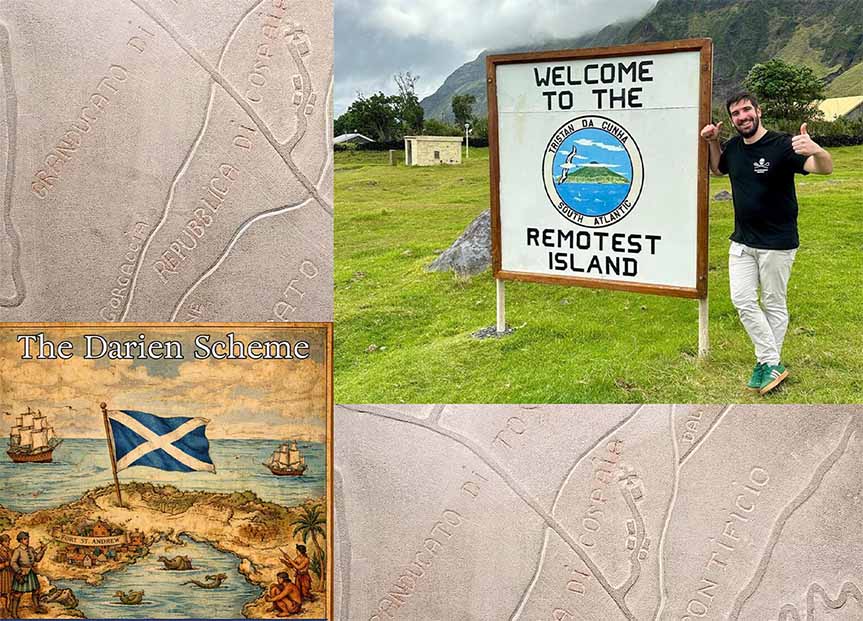
Let’s start with New Caledonia. No, not the Pacific island we know today. This was Scotland’s disastrous attempt in the late 1600s to establish a colony in the Darién region of modern-day Panama in Central America. Scotland had grand plans to create a trading hub between the Atlantic and Pacific oceans, and around 1,200 settlers sailed for their new colony. The Scots were met with torrential rain, disease, inadequate supplies and one of the world’s most unforgiving jungles. To make matters worse, English colonies were instructed not to help them in any way.
Before Scotland fully understood how badly the first expedition had failed, another was already on its way. Around 2,000 people eventually died, and Scotland lost an estimated quarter of the nation’s wealth. The disaster pushed Scotland towards its 1707 political union with England. It lost far too much money on the endeavour.
Today, more than 300 years later, the Darién Gap remains notoriously brutal. The Pan-American Highway still stops at the edge of its dense jungle and, in recent years, the area has become a major route for migrants travelling north through Central America, bringing with it violence, exploitation and human trafficking.
THE ISLANDS OF REFRESHMENT
Tristan da Cunha is one of the world’s most isolated inhabited islands, sitting alone in the South Atlantic Ocean, roughly halfway between southern Africa and South America. Its nearest mainland is South Africa, more than 2,400 kilometres away.
Portuguese naval commander Tristão da Cunha first sighted it in 1506 on a voyage to India. In 1811, American adventurer Jonathan Lambert declared himself Lord and Prince of the islands and renamed them the Islands of Refreshment. Lambert disappeared and was presumed drowned the following year, but the small settlement survived and eventually became a communist British Overseas Territory.
Today, all land is communally owned, outsiders can’t simply move there and buy property, and even UK visitors need permission before travelling to the island. Tristan da Cunha is a communist oddity under the protection of the capitalist-leaning United Kingdom. Local Council enforces strict limits on livestock accumulation and types of work. Expenses and profits are shared equally amongst the small community. The local government is the island’s sole employer, controlling everything from essential services to the supermarket. Private enterprise is suffocated by the government. Maybe that’s why so many youngsters with ambition are keen to leave and never look back. They usually flee to the UK, which grants islanders the right to full British citizenship.
To protect their supposed socialist utopia, the government needs to micromanage the economy and lock the island down under the strictest immigration laws in the world. It makes you wonder what would happen if they were flooded with immigrants bringing in new wealth and opportunity. Communism doesn’t survive free trade.
COSPAIA
This brings me to a tiny territory that took the opposite approach. Instead of controlling trade, restricting commerce, and concentrating power, Cospaia spent centuries letting people do as they pleased. Its success rested on two simple principles:
1. Do all you have agreed to do. This formed the basis of contract law.
2. Do not encroach on other persons or their property. This formed the basis of tort law and some criminal law.
Unlike Tristan da Cunha, Cospaia didn’t survive because it was isolated in the middle of an ocean. It sat right under the noses of some of Europe’s most powerful governments.
Of all 48 stories, Cospaia fascinated me the most. Cospaia did something we’re repeatedly told shouldn’t work. It survived for almost 400 years with no formal government and no taxation. To put things in perspective, the USA is currently 250 years old, and Australia is 125 years old. Even the romanticised Roman Republic only lasted 96 years longer than Cospaia. So how does a country with virtually no government survive and thrive for so long? And how does somewhere with such a remarkable history remain hidden from the history books taught in school?
Cospaia’s motto was: Perpetua et firma libertas: Perpetual and secure freedom.
Cospaia wasn’t born from revolution or war. A cartographer simply drew the boundary wrong and left it off the map. In 1440, Pope Eugene IV was broke and transferred territory to the Republic of Florence. The boundary was supposed to follow a stream commonly known as “the Rio”. Fortunately, for Cospaians, there were two streams called “the Rio”, roughly 500 metres apart. Florence used one river to make their map. The Papal States used the other. Between them sat a tiny strip of land neither had claimed. The inhabitants suddenly realised they now belonged to no government. They became the Republic of Cospaia and quickly found ways to capitalise on such a mistake.
Tobacco made its way to Europe from the Americas. The Papal States eventually restricted tobacco, but Cospaia wasn’t subject to Papal law. Demand for tobacco skyrocketed in surrounding regions, and for Cospaia, it became a cash crop. Merchants arrived, trade flourished, and money flowed freely, as it was not subject to tax.
Cospaia did not have to pay to support a king, standing army, police force, prison, or conventional government. Families and community elders simply dealt with disputes amongst themselves, and important matters were resolved at the local Church. Because people knew and trusted each other and did not want to become ostracised, they willingly submitted to their elders and the decisions of their peers. Cospain residents weren’t paying taxes and duties imposed by their powerful neighbours. This allowed them to quickly grow wealthy, free from interference. Neighbours benefitted from their tax-free status and production of tobacco. It was in everybody’s interest to protect this useful enclave.
If governments protect us from chaos… Where was the chaos?
The Chaos eventually arrived, and ironically it came in the form of jealous neighbouring governments. We’re often told government is what stands between civilisation and chaos. Without government, police, taxation and regulation, surely society would collapse… Wouldn’t it?
Cospaia stubbornly refused to follow the script. For four centuries, this tiny community enjoyed freedoms its neighbours did not. Eventually the Papal and Tuscan governments grew envious of its wealth and success and decided they would like to steal it.
In 1826, after almost 400 years of independence, the Cospaians were given an ultimatum and ultimately surrendered their tiny republic to their powerful neighbours. There was no war, no bloody invasion, and no heroic last stand. What did its inhabitants receive in return for surrendering centuries of independence? They each received a single silver coin and the right to keep growing tobacco.
AN UNCOMFORTABLE QUESTION
Cospaia is gone, but the village remains. You can visit it today in Umbria, Italy, where its remarkable history and old motto can still be observed at the local Church of the Annunziata.
There’s an old idea that if a lie is repeated often enough, eventually people accept it as truth. We’re repeatedly told that without government there would be chaos and without taxation society couldn’t function.
But if that is true, how did Cospaia survive for 386 years?
Perhaps an even more uncomfortable question is this: if a tiny society could remain peaceful, prosperous and independent for nearly four centuries with virtually no government, no taxation and no standing army, why is its story entirely absent from the history we are taught in schools?
Published Chitchat Newspaper October 2026