

Picture Australia sixty years ago.
Dad went off to work. Mum stayed home with the children. The mortgage was paid from a single wage. Dinner was on the table most nights, meat and three veg. (You better not even think of putting your elbows on that table!). Neighbours knew each other. Sports clubs relied on volunteers. Grandparents often lived close by. Weekends were for leisure, and kids went off on outdoor adventures until the streetlights came on.
Life was not perfect by any stretch of the imagination. Stay-at-home mums worked tirelessly, raising children, caring for relatives, maintaining households, and supporting their communities. Houses were simple. Cars were thirsty on fuel. Holidays were unpretentious. Families owned fewer possessions and luxuries.
Yet many Australians remember something that now feels VERY RARE…
TIME.
Time to raise children. Time to help a mate. Time to volunteer at the local footy club. Time to host a party or entertain guests. Time to read a book or sit on the veranda and watch the world go by.
What happened? How did we arrive at a place where both partners need to work full-time jobs just to put food on the table and a roof over their heads? We are now busier than ever. Where’s our money going? Who declared war on our time?
Have you heard of Tax Freedom Day?
Tax Freedom Day usually falls in mid-April. It marks the day when the average Australian has earned enough to pay their Federal, State, and Local Taxes.
In simple terms, Australians spend the first 109 days of the year working to pay tax before they begin earning for themselves.
Doesn’t it just warm your heart to know we are busier than ever before, coughing up time and money to cover the running expenses of a morbidly obese government? In the past, such inconvenience was placed on a sole breadwinner. Not anymore.
Thanks to workplace gender equality, both men and women now have equal opportunities. The opportunity to feed hungry government coffers. And the most lucrative form of tax is income tax.
That raises an interesting question…
Did one or both of your grandparents earn taxable income?
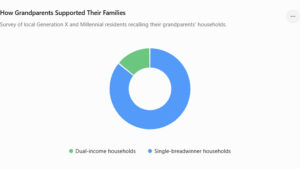
I recently hit the streets and asked local Generation X (born 1965–1980) and Millennial (born 1981–1996) residents that simple question.
The answers were astounding. It was found that 9 out of every 10 families had only one grandparent earning a taxable income.
The survey found that 86% of grandparents relied on a single breadwinner. Only 14% lived in dual-income households.
It gets more interesting. Many of the dual-income households were family farms. Both grandparents worked, but often within the same family enterprise rather than in separate paid occupations.
Why do most households now require dual-income earners?
We already covered increasing income taxes. But here are some other points to consider…
Housing costs in most areas have risen dramatically. Utilities, insurance, education, childcare, and transport consume a larger share of household budgets. Inflation, also known as the hidden tax, steadily erodes purchasing power. Every year, the Australian dollar buys a little less.
This is the assault on the dollar. The consequence is an assault on your time.
Today, many households require two taxable incomes to maintain a standard of living that previous generations achieved on one. More hours are spent working. Fewer hours are spent socialising, playing with the kids, volunteering, or simply enjoying life. Fights concerning money remain one of the biggest factors contributing to Western divorce rates.
Something’s got to give.
Usually, it is family time. Community involvement. Volunteering. Leisure. Rest.
Time has become the scarcest resource of all.
Why?
Written by John E Middleclass.
Published July 2026. Chitchat Newspaper.